We use Google Analytics to understand how visitors use this site. Analytics cookies are only activated with your consent. For details, read our Privacy Policy.
Profile lensThe same player, read from a different angle.
Athletic81
Acceleration
90
Pace
90
Agility
86
Strength
79
Balance
72
Jumping
68
Stamina
81
Fitness
82
Technical77
Dribbling
83
Short Passing
72
Long Passing
72
Finishing
79
Shot Accuracy
72
Shot Power
80
Shooting Technique
70
Heading
68
Tackling
48
Crossing
73
Free Kick
63
Penalties
66
First Touch
82
Mental72
Composure
72
Aggression
75
Consistency
74
Creativity
81
Leadership
68
Work Rate
72
Tactical73
Vision
73
Off the Ball
79
Defensive Positioning
52
Teamwork
72
Anticipation
74
Marking
42
Attacking74
Crossing
73
Finishing
79
Heading Accuracy
68
Shot Accuracy
72
Off the Ball
79
Technique74
Dribbling
83
Free Kick
63
Short Passing
72
Long Passing
72
First Touch
82
Shot Technique
70
Movement85
Acceleration
90
Pace
90
Agility
86
Balance
72
Physicality78
Shot Power
80
Jumping
68
Stamina
81
Strength
79
Fitness
82
Defending47
Marking
42
Tackling
48
Def. Positioning
52
Mentality & Game Reading73
Aggression
75
Composure
72
Penalties
66
Vision
73
Leadership
68
Work Rate
72
Teamwork
72
Anticipation
74
Consistency
74
Creativity
81
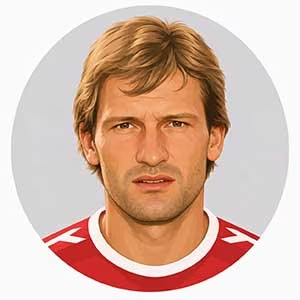
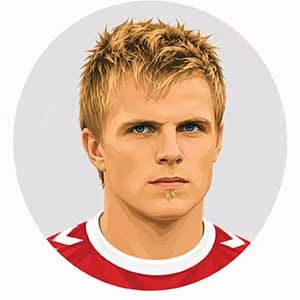
Denmark - Right WingerGrønkjær, Jesper
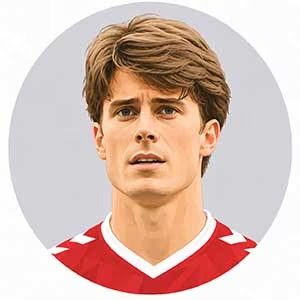
Few wingers in modern European football have ever possessed the raw, electric linear acceleration and high-octane touchline dynamism of Jesper Grønkjær. Born in Nuuk, Greenland, before rising through AaB Aalborg, Grønkjær became an international sensation at Ajax, Chelsea, Birmingham City, Atlético Madrid, VfB Stuttgart, and FC Copenhagen. Blessed with explosive initial burst speed over the first five yards and a natural, bilateral ability to beat full-backs on either the outside or the inside, he was the classic touchline-stretching wide weapon. His game was defined by high-tempo verticality: dropping his shoulder, knocking the ball past his marker into open grass, and delivering whipped crosses into the corridor of uncertainty or firing low, driven shots across the face of goal. His most culturally and financially seismic club moment arrived on the final day of the 2002–03 Premier League season with Chelsea against Liverpool—scoring the decisive curling winner in the legendary "billion-pound match" that secured Champions League qualification and directly paved the way for Roman Abramovich’s transformative takeover of the club. Earning 80 caps for Denmark, he featured across two World Cups (2002, 2010) and two European Championships (2000, 2004), later returning to Copenhagen to orchestrate four Danish Superliga titles and memorable Champions League knockout runs. Psychologically, Grønkjær was a deeply sensitive, thoughtful, and introverted artist who played football with immense personal passion while remaining refreshingly detached from the superficial vanity of modern sporting celebrity. He operated on sharp emotional currents; when he was in full flight, his self-belief was practically uncontainable, yet his game was intimately bound to his internal emotional state and rhythm. The defining test of his emotional courage occurred at Euro 2004 in Portugal: following the tragic passing of his mother just days before the tournament, Grønkjær briefly stepped away to grieve before making an emotionally charged return to the squad, coming off the bench against Bulgaria to score a deeply moving, cathartic goal that cemented his status as a beloved national hero. Inside the dressing room, he was a quiet, articulate, and immensely respected presence—free of ego, exceptionally well-liked across multiple European leagues, and serving as a calming, mature influence for younger Danish players in his later years. Under high-stakes tournament pressure, his mental posture was characterized by sudden, fearless technical impulses, using his breathtaking pace to alter the complexion of a match in a split second. Toward referees and aggressive defenders who routinely targeted his explosive runs with cynical slide tackles, Grønkjær carried himself with pristine Nordic sportsmanship: absorbing heavy contact without theatrical embellishments, avoiding petulant dissent, and letting his blistering recovery speed and wide artistry leave an indelible mark on Danish football.


 All Time ChelseaClub