We use Google Analytics to understand how visitors use this site. Analytics cookies are only activated with your consent. For details, read our Privacy Policy.
Profile lensThe same player, read from a different angle.
Athletic85
Acceleration
81
Pace
84
Agility
77
Strength
83
Balance
82
Jumping
90
Stamina
88
Fitness
91
Technical78
Dribbling
77
Short Passing
74
Long Passing
78
Finishing
58
Shot Accuracy
63
Shot Power
86
Shooting Technique
66
Heading
85
Tackling
86
Crossing
72
Free Kick
62
Penalties
68
First Touch
75
Mental80
Composure
82
Aggression
85
Consistency
79
Creativity
64
Leadership
82
Work Rate
81
Tactical81
Vision
72
Off the Ball
64
Defensive Positioning
85
Teamwork
81
Anticipation
84
Marking
85
Player Traits
Attacking68
Crossing
72
Finishing
58
Heading Accuracy
85
Shot Accuracy
63
Off the Ball
64
Technique72
Dribbling
77
Free Kick
62
Short Passing
74
Long Passing
78
First Touch
75
Shot Technique
66
Movement81
Acceleration
81
Pace
84
Agility
77
Balance
82
Physicality88
Shot Power
86
Jumping
90
Stamina
88
Strength
83
Fitness
91
Defending85
Marking
85
Tackling
86
Def. Positioning
85
Mentality & Game Reading78
Aggression
85
Composure
82
Penalties
68
Vision
72
Leadership
82
Work Rate
81
Teamwork
81
Anticipation
84
Consistency
79
Creativity
64
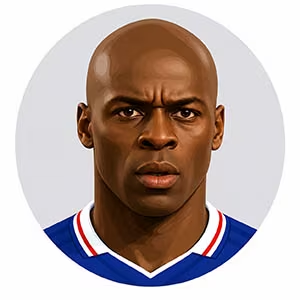
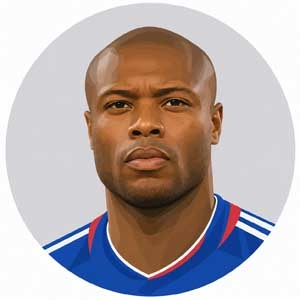
France - Centre-backGallas, William
Born in Asnières-sur-Seine, near Paris, in 1977, Gallas was a technically composed, physically capable defender equally proficient at centre-back and left-back, quick enough to defend in either role and comfortable enough in possession to contribute meaningfully to build-up play, a versatility that made him valuable to a series of ambitious clubs across two countries. He came through Caen and Marseille before establishing himself at Chelsea in 2001, where he became an important part of the side's transformation under Claudio Ranieri and then José Mourinho, winning two Premier League titles and two League Cups. His move to Arsenal in 2006, part of a controversial swap deal involving Ashley Cole that generated considerable hostility from Chelsea supporters, initiated a five-season spell in which he captained the club, before a move to Tottenham extended his Premier League career further, and a final stretch back in France with Perpignan closed a two-decade professional career. For France he won 84 caps, played at the 2006 World Cup final and the dysfunctional 2010 tournament, and was a regular international centre-back for the better part of a decade.
His limitations were less about ability, which was rarely questioned by opponents or teammates, and more about the recurring pattern of relational breakdown that accompanied his considerable talent. Defensively he could be positionally inconsistent in a way that occasionally undermined his individual quality, and his versatility, while valuable, sometimes meant he was shuffled between centre-back and left-back in ways that prevented him from settling fully into either role's specific demands. Physically he remained effective into his mid-thirties, which made the recurring institutional conflicts throughout his career less attributable to declining ability than to something more consistently temperamental.
Temperamentally he was the corpus's clearest case of a gifted player whose relationship with institutional authority repeatedly and specifically broke down, across multiple clubs and countries, in ways too frequent to read as isolated incidents. Gallas forced his way out of Chelsea by publicly stating he no longer wished to play for the club, a declaration that damaged his reputation with supporters considerably. At Arsenal, his captaincy ended in public humiliation: substituted and visibly distraught during a match at Birmingham City in 2008, he later sat alone on the pitch after the final whistle in a scene widely interpreted as a breakdown in his relationship with his own teammates, and Arsène Wenger stripped him of the armband within months, citing conduct concerns. He was similarly outspoken during the French national team's 2010 World Cup implosion, one of the more vocal and visible figures in a squad revolt that ended the tournament in disarray and considerable national embarrassment. Across these episodes a consistent pattern emerges: not calculated confrontation of the Cruyff variety, and not slow-burning resentment like Guti's, but a comparatively low threshold for open conflict once he perceived disrespect, expressed immediately and publicly rather than absorbed privately. He was, by numerous accounts, respected individually by teammates for his professionalism in training and his defensive quality, which sat uncomfortably alongside a documented history of institutional rupture severe enough to follow him across borders. Away from the pitch his profile after retirement remained relatively modest, without the sustained controversy that had periodically defined his playing career. Talented, versatile and recurrently at odds with the structures he played within, Gallas offers the corpus its most consistent case of institutional conflict as a repeating professional pattern rather than a single career-defining incident.


 All Time ChelseaClub