We use Google Analytics to understand how visitors use this site. Analytics cookies are only activated with your consent. For details, read our Privacy Policy.
Profile lensThe same player, read from a different angle.
Athletic80
Acceleration
74
Pace
79
Agility
73
Strength
85
Balance
77
Jumping
86
Stamina
83
Fitness
80
Technical78
Dribbling
75
Short Passing
75
Long Passing
77
Finishing
64
Shot Accuracy
72
Shot Power
83
Shooting Technique
66
Heading
83
Tackling
86
Crossing
71
Free Kick
68
Penalties
68
First Touch
76
Mental80
Composure
78
Aggression
82
Consistency
80
Creativity
64
Leadership
86
Work Rate
81
Tactical81
Vision
73
Off the Ball
65
Defensive Positioning
85
Teamwork
82
Anticipation
82
Marking
84
Attacking71
Crossing
71
Finishing
64
Heading Accuracy
83
Shot Accuracy
72
Off the Ball
65
Technique73
Dribbling
75
Free Kick
68
Short Passing
75
Long Passing
77
First Touch
76
Shot Technique
66
Movement76
Acceleration
74
Pace
79
Agility
73
Balance
77
Physicality83
Shot Power
83
Jumping
86
Stamina
83
Strength
85
Fitness
80
Defending85
Marking
84
Tackling
86
Def. Positioning
85
Mentality & Game Reading78
Aggression
82
Composure
78
Penalties
68
Vision
73
Leadership
86
Work Rate
81
Teamwork
82
Anticipation
82
Consistency
80
Creativity
64
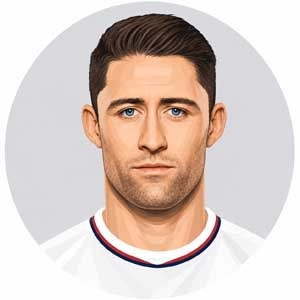
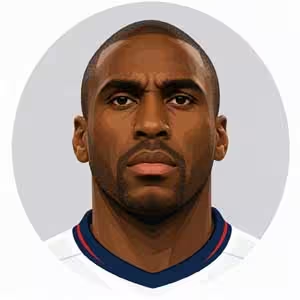
England - Centre-backCahill, Gary
Aston Villa released Gary Cahill at sixteen, despite the fact that he had captained England's youth sides, and sent him on a loan to Burnley where, by his own later admission, he barely played because he simply wasn't ready. A decade and a half later he lifted the Champions League as Chelsea's captain, having become one of the most trusted defenders English football produced in that generation — a career built entirely on the gap between that early rejection and everything that followed it.
Born in Dronfield, Derbyshire, in 1985, Cahill was a tall, physically committed centre-back whose game rested on aerial dominance, positional discipline and an evident willingness to put his body in front of shots rather than any particular technical flair. After the setback at Villa and a difficult loan spell, he found his footing at Bolton Wanderers under Sam Allardyce, later describing the club and its stadium as feeling like home from the first day and crediting the experience directly with making him as a professional. Chelsea signed him from Bolton in January 2012 at twenty-six, and he went on to make more than 500 appearances for the club across seven and a half seasons, winning the Champions League that same year in an all-Munich final, two Premier League titles, two FA Cups, two Europa Leagues and a League Cup, eventually inheriting the captaincy from John Terry. For England he won 61 caps between 2010 and 2018, played at the 2012 and 2016 European Championships and the 2014 World Cup, and captained the national side on occasion as well.
His limitations were the standard ones for a defender of his profile: Cahill was not the most technically gifted centre-back of his generation, and his path through the lower reaches of English football before establishing himself meant he arrived at the top level later than more precocious contemporaries, with a correspondingly shorter prime at the very highest standard. His reputation, by his own club's account, was somewhat unglamorous relative to more visible teammates — solid rather than spectacular, valued for consistency rather than for moments that generated headlines on their own.
Temperamentally he was defined by resilience following early disappointment and by a quiet, trusted form of leadership that both Chelsea and England repeatedly rewarded with the captaincy. He spoke about the Villa rejection and the difficult Burnley loan with straightforward honesty rather than bitterness, treating the setback as a formative rather than a scarring experience, and he credited Bolton's environment specifically for the professional identity that carried him to the top. He was consistently described as respected within every dressing room he occupied — the kind of player teammates trusted with the armband not because he demanded it but because his reliability over time earned it. Away from the pitch his profile remained modest and largely free of controversy across a two-decade career. Steady, unflashy and defined by a career-long arc from rejection to captaincy, Cahill built his reputation on doing, reliably and without complaint, exactly what was asked of him.