We use Google Analytics to understand how visitors use this site. Analytics cookies are only activated with your consent. For details, read our Privacy Policy.
Profile lensThe same player, read from a different angle.
Athletic77
Acceleration
85
Pace
76
Agility
77
Strength
74
Balance
77
Jumping
70
Stamina
75
Fitness
79
Technical84
Dribbling
88
Short Passing
85
Long Passing
85
Finishing
84
Shot Accuracy
82
Shot Power
81
Shooting Technique
81
Heading
72
Tackling
33
Crossing
80
Free Kick
83
Penalties
96
First Touch
89
Mental81
Composure
92
Aggression
65
Consistency
71
Creativity
88
Leadership
83
Work Rate
71
Tactical79
Vision
84
Off the Ball
84
Defensive Positioning
35
Teamwork
74
Anticipation
76
Marking
40
Player Traits
Attacking80
Crossing
80
Finishing
84
Heading Accuracy
72
Shot Accuracy
82
Off the Ball
84
Technique85
Dribbling
88
Free Kick
83
Short Passing
85
Long Passing
85
First Touch
89
Shot Technique
81
Movement79
Acceleration
85
Pace
76
Agility
77
Balance
77
Physicality76
Shot Power
81
Jumping
70
Stamina
75
Strength
74
Fitness
79
Defending36
Marking
40
Tackling
33
Def. Positioning
35
Mentality & Game Reading80
Aggression
65
Composure
92
Penalties
96
Vision
84
Leadership
83
Work Rate
71
Teamwork
74
Anticipation
76
Consistency
71
Creativity
88
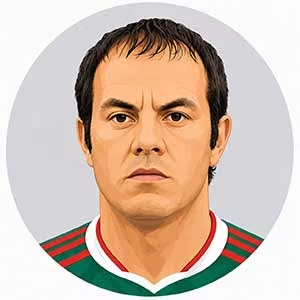
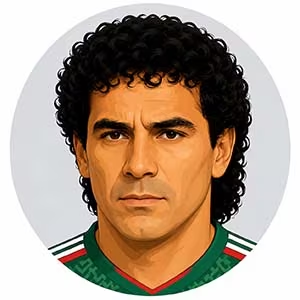
Mexico - ForwardBlanco, Cuauhtémoc
As a boy Cuauhtémoc Blanco sold pirated cassette tapes on the streets of Tepito, the toughest and most storied working-class neighborhood in Mexico City, long before anyone outside it had heard his name. By his mid-twenties he had a nickname borrowed from the last Aztec emperor, one who chose death over surrender to Cortés, and a signature move so strange it had to be seen to be believed: trapping the ball between his ankles and hopping clean over two defenders at once, ball still glued to his feet on landing. He unveiled it against South Korea at the 1998 World Cup, did it again against Germany in the same tournament, and turned an obscure training-ground trick, invented to escape a teammate who kept kicking at his ankles in a small-space drill, into one of the most recognizable pieces of skill the World Cup has ever produced.
Born in Mexico City in 1973, Blanco was recruited by Club América at fifteen and made his first-team debut at nineteen. He played mostly as a second striker or attacking midfielder, blending genuinely elegant dribbling — feints and sudden changes of direction that made him difficult to read in one-on-one situations — with a physical, combative style more associated with defenders than playmakers, and a shot and vision good enough to make him one of the most complete attacking players Mexican football has produced. He spent most of two decades at Club América, becoming the club's second-highest all-time scorer, before a difficult loan season at Real Valladolid in Spain exposed the limits of his adaptability outside Mexico. He joined Chicago Fire in 2007 as one of MLS's first Designated Players alongside David Beckham's arrival at LA Galaxy, drawing crowds of Mexican and Mexican-American fans who treated him as a genuine idol rather than a marketing signing, before a well-traveled final stretch through Veracruz, Irapuato, Dorados, Lobos BUAP and Puebla closed a playing career of more than two decades. For Mexico he won 122 caps and scored 39 goals, played at the 1998, 2002 and 2010 World Cups — becoming the first Mexican to score in three different tournaments — and led El Tri to the 1999 Confederations Cup title with a performance in the final against Brazil still discussed as one of the country's finest. He holds the highest career penalty conversion rate of any recognized great, 71 from 73, and remains, jointly with Ronaldinho, the all-time top scorer in Confederations Cup history.
His limitations were connected directly to the same combativeness that made him compelling to watch. Blanco struggled to adjust technically and tactically to the more physical, structured demands of Spanish football during his single European season, and never attempted another move abroad after it. His willingness to confront opponents and officials produced a genuinely poor disciplinary record across his career — he was once suspended for gouging an opponent's eye — and in MLS he was banned for two years from the US Open Cup specifically after punching an opposing player and then, resisting removal from the pitch, nearly headbutting a rival club's official, an incident for which he issued a public apology the following week. He was omitted from Mexico's 2006 World Cup squad in a decision that produced genuine national controversy, with supporters organizing a protest march to the federation's offices — a response that says as much about his standing with the public as it does about the selection itself.
Temperamentally he was, by nearly universal account, one of the most divisive figures Mexican football has produced — adored by a large public that saw its own working-class origins reflected in him, and disliked in roughly equal measure by opponents, rival fans and disciplinary committees for a fiery, confrontational manner that included insulting opposing coaches mid-match and drawing cards through calculated gamesmanship. He embraced attention on the pitch fully, courting controversy with theatrical goal celebrations, while insisting in interviews that fame had not changed his self-image; asked about it directly in 2004, he said he didn't feel famous, that he was the same as a waiter or a street sweeper, and that people who had fame and money without feelings had nothing that actually mattered. Academics studying Mexican football culture have placed him in the same category as Maradona and Garrincha — a trickster figure whose skill and rebelliousness were inseparable from his neighborhood origins, commemorated in folk ballads that name Tepito directly. That populist identity carried directly into a second career: he served as mayor of Cuernavaca beginning in 2018 and then as governor of the state of Morelos from 2018 to 2024, a tenure that drew serious and still-unresolved allegations, reported by Mexican outlets and reportedly examined by military intelligence, connecting him to organized-crime financing — controversies of a different order of magnitude than anything documented during his playing career, and ones he has denied. Skilled, combustible, beloved by a public that saw itself in him, and entangled in unresolved political controversy far graver than any football dispute, Blanco remains one of the few footballers whose second act eclipsed, for very different reasons, the fame of the first.