We use Google Analytics to understand how visitors use this site. Analytics cookies are only activated with your consent. For details, read our Privacy Policy.
Profile lensThe same player, read from a different angle.
Athletic78
Acceleration
68
Pace
71
Agility
82
Strength
86
Balance
76
Jumping
89
Stamina
68
Fitness
80
Technical40
Dribbling
50
Short Passing
54
Long Passing
58
Shot Accuracy
44
Shot Power
85
Shooting Technique
44
Heading
0
Free Kick
44
Penalties
44
First Touch
60
Mental79
Composure
83
Consistency
75
Leadership
70
Goalkeeping86
Reflexes
90
Positioning
84
Handling
84
Kicking
85
Goalkeeping86
Reflexes
90
Positioning
84
Handling
84
Kicking
85
Attacking22
Heading Accuracy
0
Shot Accuracy
44
Technique52
Dribbling
50
Free Kick
44
Short Passing
54
Long Passing
58
First Touch
60
Shot Technique
44
Physicality82
Shot Power
85
Jumping
89
Stamina
68
Strength
86
Fitness
80
Movement74
Acceleration
68
Pace
71
Agility
82
Balance
76
Mentality & Game Reading68
Composure
83
Penalties
44
Leadership
70
Consistency
75
Saudi Arabia - GoalkeeperAl-Deayea, Mohamed
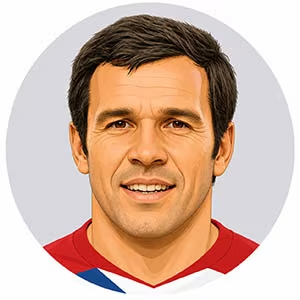
Al-Deayea was a large, reactive goalkeeper whose foundations had been formed unusually early in another sport. He began as a handball goalkeeper before switching to football, then won the 1989 FIFA youth world title with Saudi Arabia and reached the senior national team during qualification for USA 1994. At approximately 1.89 metres, he combined useful reach with unusually fast reactions, an athletic profile FIFA later characterised through composure and “lightning reflexes”. His best performances were built around shot-stopping, rapid adjustment to close-range attempts and the ability to remain active through repeated defensive emergencies. The 1994 World Cup displayed those qualities most clearly as Saudi Arabia reached the round of sixteen, while subsequent continental tournaments reinforced his status: he was central to the 1996 Asian Cup triumph and accumulated a succession of regional goalkeeping awards. His club career followed an equally stable structure. After a decade with Al-Tai, he moved to Al-Hilal in 1999 and remained there until retiring in 2010. He was fundamentally a goalkeeper whose value increased when the opposition generated shots and broken situations, rather than one whose identity depended on elaborate distribution or acting as an additional possession player.
That emphasis carried limitations. Al-Deayea’s enormous international exposure included matches in which Saudi Arabia were structurally overwhelmed, and repeated emergency saving could not compensate indefinitely for weak protection in front of him. Across his ten actual World Cup appearances from 1994 to 2002, Saudi Arabia conceded twenty-five goals; seven of those ten matches were defeats. The 2002 tournament especially exposed the boundary between individual shot-stopping and systemic control: a goalkeeper can react well to individual attempts without possessing any mechanism capable of restoring a defensive structure that repeatedly allows free headers, uncontested deliveries and successive entries into the box. His style was also less valuable when evaluated through later expectations of goalkeepers as primary build-up initiators. Distribution was functional rather than the defining source of team progression. Nor should longevity erase decline. By 2006, although still selected for the World Cup squad, he had lost the starting role to Mabrouk Zaid and did not play in Germany. That was a hierarchy change, not evidence that major-event pressure had suddenly degraded him: he had already accumulated three World Cups as a starter and remained successful with Al-Hilal afterwards.
The psychologically distinctive pattern is high operational acceptance combined with retained internal grievance. Al-Deayea repeatedly described himself as a player who did not interfere with coaches’ technical decisions and who respected selection even when he disagreed with it. In a contemporary interview after the 2006 World Cup, he explicitly denied rumours that he had argued with Marcos Paquetá about tactics and said that throughout his career he had left technical decisions to the coach. Yet the exclusion mattered deeply. He later stated that he felt wronged by being denied even a brief appearance in 2006 and wanted to understand what he had done to deserve it. When subsequently told that Paquetá might return to coach Al-Hilal, however, Al-Deayea immediately accepted the appointment because he considered the club’s interests more important than his personal grievance; Paquetá later encountered him joking normally and was surprised that the World Cup episode had not produced lasting hostility. This should not be flattened into obedience. Al-Deayea remembered the perceived injustice for years and publicly challenged the circumstances surrounding it, but he separated disagreement from professional obstruction. The same separation appears after the German defeat: humiliation remained emotionally meaningful, yet no evidence shows it producing withdrawal, public blame of teammates or deterioration into retaliatory behaviour. Evidence for persistent referee confrontation, provocation-driven aggression or hostility toward teammates’ mistakes is insufficient and must remain unknown. What is documented is narrower and more valuable: he could carry resentment without requiring immediate behavioural discharge. For an extractor, that distinction matters enormously. Low outward conflict did not mean low emotional investment; it meant unusually strong containment between what he felt and what he allowed to interfere with role performance.



 All-Time AsiaAsia