
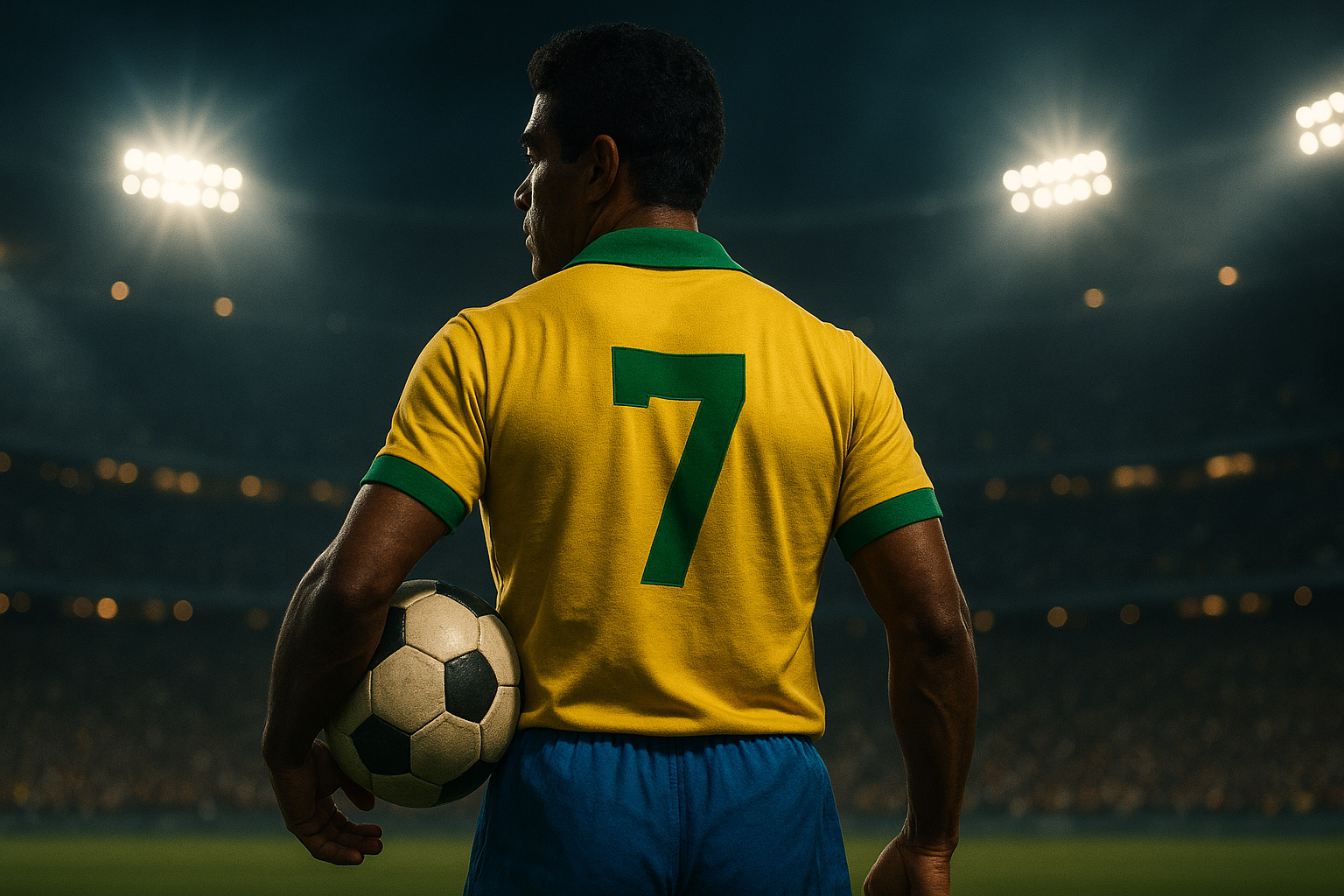
His little sister Rosa was the first to notice it. The way the child moved — free, unpredictable, impossible to pin down — reminded her of a tiny bird native to their region of Brazil. A garrincha. Also known as the cambaxirra. The nickname stuck. And what a cruelly perfect nickname it was: because the bird everyone would spend a lifetime trying to catch, nobody ever could.
Manoel Francisco dos Santos grew up in Pau Grande, a small town near Rio, in a state of near-feral poverty. Alcohol, cigarettes, hunger. Football was not an escape — it was the only language he spoke fluently. From the very first time he touched a ball, no one could take it from him. Not the older kids. Not the greatest defenders in the world. Nobody.
Here is the part of the story where the doctors got everything wrong. When Garrincha was assessed as a teenager, the medical report was, by any reasonable standard, a death sentence for any sporting career. It likely read something like this:
What the doctors catalogued as defects, football would transform into weapons. His shorter leg — the one that should have made him limp — gave his body an unpredictable geometry that no defender could decode. His hips swayed one way, the ball went the other, and grown men who had spent their lives reading bodies were left grabbing at air. His deformities weren't limitations. They were his style.
Garrincha spent his teenage years playing for local factory teams, completely indifferent to the idea of a professional career. His friends, not he himself, had to drag him to his trials. He forgot his boots at Vasco da Gama. He didn't take São Cristóvão or Fluminense seriously. For Mané, football wasn't a job. It was play.
In 1951, at 19, someone finally got him to try out for Botafogo. The coach, intrigued by what he'd seen from the reserves, arranged a test match: first team against the reserves, with Garrincha playing for the latter. His direct opponent was Nilton Santos — captain of Botafogo, captain of the national team, widely regarded as the greatest left back of his generation.
Garrincha humiliated him. Over and over. Nutmegs, feints, dummies, sudden acceleration. Santos — a man who had seen everything — was left helpless. The story goes that after the match, Nilton Santos marched straight to the club president and told him: sign the boy, or I quit. And so began the professional career of Manoel Francisco dos Santos.
There is a statistic so extraordinary that it sounds invented. In 40 international matches in which both Pelé and Garrincha played for Brazil at the same time, their team was never once defeated. 35 wins. 5 draws. Zero losses. It is the most complete partnership record in the history of the sport — not merely dominant, but literally flawless. No other pairing of two players can claim anything close.
The 1958 World Cup should have been his introduction to the world. Instead, it nearly began as a scandal. Garrincha was benched for the first two matches — a decision that some attribute to racial bias within the Brazilian delegation, with certain officials reportedly believing white players were better suited for the tactical rigour of European opposition.
When he was finally given his chance, the question answered itself. Every time he stepped onto the pitch, he turned defenders into spectators. His two assists in the final against Sweden helped striker Vavá complete a 5–2 victory. Brazil lifted their first World Cup. His teammates wept. Garrincha stood in the middle of the pitch, genuinely confused, and turned to captain Bellini: "When do we play the second leg?"
He wasn't joking. He simply hadn't understood what had just happened. That quality — total, childlike immersion in the game itself — was Garrincha's defining trait. Football didn't give him fame. Football gave him the ball.
If 1958 made him famous, 1962 made him immortal. Pelé suffered a muscle injury in Brazil's second group game, fouled repeatedly by opponents who'd decided neutralising him was the only viable strategy. He played no further part in the tournament.
So Brazil — the reigning world champions, suddenly without their greatest player — turned to Garrincha. And Garrincha carried them. Not as a supporting actor. As the protagonist, the narrator, and the director simultaneously. He scored. He assisted. He dominated every match. He finished the tournament as both top scorer and best player — two distinctions, at the same World Cup, for the same man who had come to fill an impossible gap.
Against Czechoslovakia, the opposition attempted something unprecedented: assigning three defenders specifically to mark Garrincha. It achieved nothing. Alongside Diego Maradona in Mexico 1986, he is perhaps the only player in history who can be said to have won a World Cup essentially through individual brilliance alone. Two men, two tournaments, one category of achievement that belongs to nobody else.
Garrincha belongs to a lineage of players who treated the ball not as a tool, but as a companion. Players who dribbled not because the tactics called for it, but because they simply could not help themselves — because it was the most natural expression of who they were.
By the early 1980s, Garrincha had long retired from football. He moved to Italy with his then-partner, singer Elza Soares, settling in Torvaianica near Rome. The decline was visible to anyone who looked. He drank heavily. He had gained weight. He became a brand ambassador for the Brazilian Coffee Institute in Italy — a man who had carried a nation's dreams reduced to a promotional role.
And then, he played again. Manoel Francisco dos Santos — two-time World Cup winner, the greatest right winger who ever lived — signed for Sacrofano, a tiny club from a village of 2,000 people near Rome, competing in Italy's sixth division. His old friend Dino da Costa, a former AS Roma star who coached the team, convinced him to come.
A slow, out-of-shape Garrincha still dragged Sacrofano to victory in a four-team tournament, scoring twice directly from corner kicks. People who were there swear he was spotted kicking a ball around with children in Campo de' Fiori on Saturday nights. I believe it completely. Because Mané was, at heart, a child who never stopped playing. Football had always been his game — long before it was anyone's career.
Telmo Zanini, in his biography Mané Garrincha, described his final years with devastating honesty: detached from society, lost to alcoholism, fourteen children scattered across the world, sleeping in doorways and on pavements, surviving on the occasional goodwill of strangers. Fame had arrived like a tidal wave and left him stranded. The fake friends vanished. The vices stayed.
Then came that January night in 1983. After three days of drinking, his body gave out. A pulmonary edema. Mané took flight one last time.
Garrincha was not the most decorated Brazilian player. He was not the most famous. He was not the most disciplined, the most professional, or the most celebrated outside his country's borders. But he was, more than any of them, the true darling of the Brazilian people. They loved him not for his trophies but for his honesty — the honesty of a man who played exactly as he was, without pretence, without performance, without calculation.
Football was both his salvation and his downfall. It gave him a world he could understand. And the world gave him back something he never knew how to handle.