We use Google Analytics to understand how visitors use this site. Analytics cookies are only activated with your consent. For details, read our Privacy Policy.
Profile lensThe same player, read from a different angle.
Athletic85
Acceleration
81
Pace
86
Agility
77
Strength
90
Balance
88
Jumping
89
Stamina
87
Fitness
82
Technical76
Dribbling
71
Short Passing
72
Long Passing
73
Finishing
64
Shot Accuracy
63
Shot Power
90
Shooting Technique
64
Heading
82
Tackling
88
Crossing
67
Free Kick
71
Penalties
70
First Touch
73
Mental79
Composure
84
Aggression
85
Consistency
78
Creativity
68
Leadership
80
Work Rate
74
Tactical80
Vision
73
Off the Ball
62
Defensive Positioning
85
Teamwork
75
Anticipation
82
Marking
87
Player Traits
Attacking68
Crossing
67
Finishing
64
Heading Accuracy
82
Shot Accuracy
63
Off the Ball
62
Technique71
Dribbling
71
Free Kick
71
Short Passing
72
Long Passing
73
First Touch
73
Shot Technique
64
Movement83
Acceleration
81
Pace
86
Agility
77
Balance
88
Physicality88
Shot Power
90
Jumping
89
Stamina
87
Strength
90
Fitness
82
Defending87
Marking
87
Tackling
88
Def. Positioning
85
Mentality & Game Reading77
Aggression
85
Composure
84
Penalties
70
Vision
73
Leadership
80
Work Rate
74
Teamwork
75
Anticipation
82
Consistency
78
Creativity
68
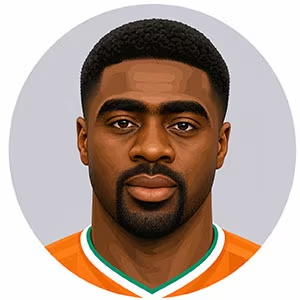
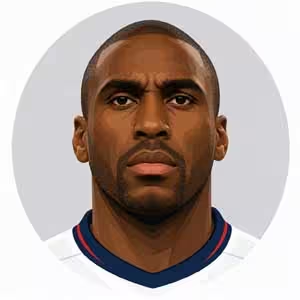
Ivory Coast - Centre-backTouré, Kolo
Kolo Touré went on to form the central defensive cornerstone of Arsenal’s historic 2003–04 Invincibles, establishing himself as one of the most athletic and resilient center-halves in modern Premier League lore. Paired alongside Sol Campbell, Touré blended blistering linear recovery pace with explosive vertical leaping and bone-jarring sliding interventions, suffocating transitions before they reached Jens Lehmann's box. Across 326 appearances for the Gunners, he lifted the 2003–04 Premier League title and two FA Cups, before completing a high-profile switch to Manchester City, where he captained the early Mancini era to the 2011–12 Premier League crown, later achieving a second undefeated league campaign with Brendan Rodgers’ Celtic in 2016–17. For Ivory Coast, across 120 caps and seven goals, he was a foundational pillar of Les Éléphants across three World Cups (2006, 2010, 2014) and conquered the 2015 Africa Cup of Nations.
His reliance on raw kinetic recovery, however, masked occasional positional and spatial vulnerabilities. Touré was an aggressive, front-foot marker who occasionally overcommitted on initial challenges, leaving yawning gaps behind him if an elusive forward spun away on a quick give-and-go. Furthermore, his distribution under intense central pressing was functional rather than inventive, and following a six-month suspension in 2011 alongside natural physical wear, his sharp turning agility declined, exposing him in isolated footraces against dynamic dribblers.
Infectiously joyful, intensely loyal, and driven by an indefatigable work ethic, Touré was a dressing-room catalyst across every club he represented. He had zero tolerance for sulking or tactical indifference, bringing relentless energy to every training drill and matchday warm-up. On the pitch, his body language was all heart and commitment: hurling himself into low crosses, sprinting forty yards to snuff out counters, and celebrating defensive clearances with roaring passion. Inside the Arsenal, Manchester City, and Ivorian national team locker rooms, he was an indispensable unifying force—a warm, charismatic big brother who bridged disparate egos and inspired teammates through unyielding physical courage, leaving behind an enduring legacy as an iconic, multi-club champion of British football.