We use Google Analytics to understand how visitors use this site. Analytics cookies are only activated with your consent. For details, read our Privacy Policy.
Profile lensThe same player, read from a different angle.
Athletic85
Acceleration
87
Pace
86
Agility
84
Strength
79
Balance
85
Jumping
86
Stamina
84
Fitness
88
Technical83
Dribbling
86
Short Passing
79
Long Passing
73
Finishing
87
Shot Accuracy
83
Shot Power
85
Shooting Technique
76
Heading
82
Tackling
44
Crossing
68
Free Kick
62
Penalties
76
First Touch
82
Mental81
Composure
82
Aggression
81
Consistency
76
Creativity
73
Leadership
83
Work Rate
84
Tactical80
Vision
73
Off the Ball
86
Defensive Positioning
33
Teamwork
78
Anticipation
85
Marking
40
Attacking81
Crossing
68
Finishing
87
Heading Accuracy
82
Shot Accuracy
83
Off the Ball
86
Technique76
Dribbling
86
Free Kick
62
Short Passing
79
Long Passing
73
First Touch
82
Shot Technique
76
Movement86
Acceleration
87
Pace
86
Agility
84
Balance
85
Physicality84
Shot Power
85
Jumping
86
Stamina
84
Strength
79
Fitness
88
Defending39
Marking
40
Tackling
44
Def. Positioning
33
Mentality & Game Reading79
Aggression
81
Composure
82
Penalties
76
Vision
73
Leadership
83
Work Rate
84
Teamwork
78
Anticipation
85
Consistency
76
Creativity
73
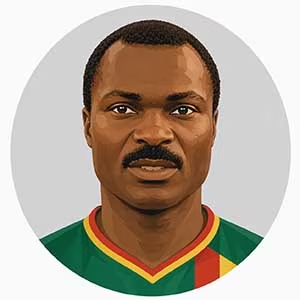
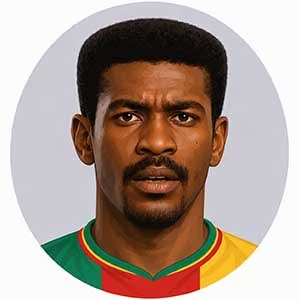
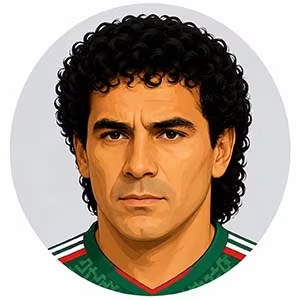
Cameroon - StrikerMilla, Roger
In Bari on 23 June 1990, Cameroon and Colombia had played 105 minutes without scoring when Roger Milla received the ball outside the penalty area, exchanged passes with François Omam-Biyik and accelerated between two defenders before beating René Higuita. Three minutes later Higuita carried the ball far outside his area and attempted to escape Milla with the ball at his feet. Milla chased him, took possession and ran into the empty goal. At thirty-eight, officially a substitute at the beginning of the tournament, he had just scored twice in extra time to send an African team into a World Cup quarter-final for the first time. His celebration at the corner flag became the enduring image, but the second goal reveals more about the player: Milla did not treat Higuita’s possession as a dead phase simply because the goalkeeper appeared to control it. He remained engaged, identified arrogance or opportunity in an abnormal situation and attacked it. The same economy characterised his tournament. He started only two of Cameroon’s five matches but scored four goals, three after entering as a substitute. Reduced minutes did not require reduced psychological presence. When the game finally offered him a situation he recognised, he behaved as though the hierarchy of age and selection had temporarily ceased to matter.
Milla had been a far more complete forward at his athletic peak than the 1990 images suggest. Quick, mobile and technically expressive, he could receive outside the penalty area, carry at defenders, combine with teammates and create separation through changes of direction rather than functioning solely as a penalty-box finisher. He won the African Footballer of the Year award in 1976 while with Tonnerre Yaoundé, then spent much of his career in France with Valenciennes, Monaco, Bastia, Saint-Étienne and Montpellier. His French record was productive without making him a dominant European scorer, but his movement, close control and ability to improvise remained useful across different attacking structures. By 1990 the physical balance had changed. Cameroon did not need the thirty-eight-year-old to reproduce the running volume of his twenties; Valery Nepomnyashchy could preserve him and introduce him against tiring defenders. Milla adapted by concentrating his game around anticipation, short accelerations, shielding, combinations and finishing. That transformation continued into 1994, when at forty-two he scored against Russia and became, at the time, the oldest scorer in World Cup history. His longevity therefore depended not on physical preservation alone but on accepting that his functional role could shrink while his attacking judgement remained valuable.
There were substantial limitations behind that adaptation. Milla’s European club career never matched the mythology created by his international tournaments, and his scoring record in France was uneven. He could be dangerous with freedom to move around defenders but was not an elite-level possession organiser or a forward whose passing could control an attack from deeper areas. Age progressively removed the sustained acceleration and repeated mobility that had characterised the younger player; by 1990 his effectiveness depended increasingly on selective deployment. That matters because his extraordinary World Cup efficiency can tempt retrospective inflation: four goals from limited minutes demonstrated devastating situational value, not evidence that he could still sustain the complete workload of a prime centre-forward over every ninety minutes. Nor did his confidence eliminate poor performances. Cameroon’s 1994 campaign ended with a 6–1 defeat to Russia despite Milla’s goal, showing again that individual opportunism could survive inside collective failure without giving him the capacity to reverse it. His degradation conditions were therefore clear: continuous high-intensity movement, prolonged defensive responsibility and attacking structures that required him to generate progression repeatedly rather than exploit the final stages of moves increasingly reduced his influence as he aged.
Psychologically, Milla’s strongest signal is **self-authorised relevance**: he accepted changes in function more readily than external judgements that his usefulness had expired. He had retired from international football before the 1990 World Cup and was recalled amid direct intervention from Cameroonian president Paul Biya. Milla later rejected the simplified story that the president personally selected him, insisting that Biya facilitated his return but that the football decision remained with the coach. That distinction itself is revealing: even when recounting the episode, Milla defended the legitimacy of his sporting value rather than accepting the image of a ceremonial veteran imposed on the team. Nepomnyashchy then used him largely from the bench, and there is no evidence that Milla responded to that reduced match role by destabilising the group; instead he produced four goals. Tactical subordination was therefore compatible with extremely high self-belief. Institutional exclusion was different. Years later Milla repeatedly criticised administrators and coaches when he believed Cameroonian football was being badly managed, and his public interventions could be severe rather than diplomatically neutral. His competitive behaviour also contained provocation without requiring loss of control: after dispossessing Higuita in 1990 he celebrated extravagantly, but the action preceding it was calculated pursuit, not retaliatory aggression. The dancing itself should not be misread as emotional lightness; Milla was capable of strong grievance, pride and public confrontation. What remains poorly documented is systematic referee conflict, responses to teammates’ individual mistakes and whether personal provocation reliably degraded his next actions. His most defensible contradiction is stronger: **he could accept fewer minutes without accepting diminished significance**. Role reduction did not necessarily threaten him because he retained an internal conviction that he could decide the match; attempts to define his relevance externally were much more likely to provoke resistance.