We use Google Analytics to understand how visitors use this site. Analytics cookies are only activated with your consent. For details, read our Privacy Policy.
Profile lensThe same player, read from a different angle.
Athletic81
Acceleration
77
Pace
81
Agility
76
Strength
83
Balance
82
Jumping
80
Stamina
84
Fitness
87
Technical82
Dribbling
83
Short Passing
83
Long Passing
78
Finishing
83
Shot Accuracy
82
Shot Power
83
Shooting Technique
81
Heading
81
Tackling
56
Crossing
74
Free Kick
71
Penalties
76
First Touch
85
Mental82
Composure
79
Aggression
80
Consistency
84
Creativity
76
Leadership
84
Work Rate
82
Tactical82
Vision
80
Off the Ball
84
Defensive Positioning
52
Teamwork
85
Anticipation
83
Marking
43
Attacking81
Crossing
74
Finishing
83
Heading Accuracy
81
Shot Accuracy
82
Off the Ball
84
Technique80
Dribbling
83
Free Kick
71
Short Passing
83
Long Passing
78
First Touch
85
Shot Technique
81
Movement79
Acceleration
77
Pace
81
Agility
76
Balance
82
Physicality83
Shot Power
83
Jumping
80
Stamina
84
Strength
83
Fitness
87
Defending50
Marking
43
Tackling
56
Def. Positioning
52
Mentality & Game Reading81
Aggression
80
Composure
79
Penalties
76
Vision
80
Leadership
84
Work Rate
82
Teamwork
85
Anticipation
83
Consistency
84
Creativity
76
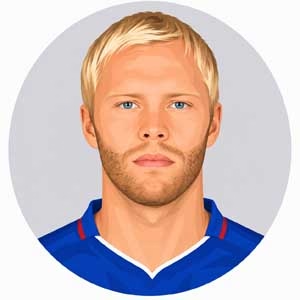
Iceland - ForwardGudjohnsen, Eidur
Tallinn, April 1996, a friendly nobody outside Iceland was watching. A thirty-four-year-old striker comes off at half-time and his seventeen-year-old son jogs on to replace him — the first father and son in football history to play for the same national team in the same match. Eiður Guðjohnsen described football afterward as something closer to inheritance than choice: he was told that from the moment he first saw a ball, he didn't look at anything else.
Born in Reykjavík in 1978, Guðjohnsen grew up watching his father Arnór star for Anderlecht in Belgium, reportedly refusing to go to bed without his Anderlecht shirt, and signed his own first professional contract at PSV Eindhoven as a teenager, training briefly alongside a young Ronaldo before a badly broken ankle nearly ended his career before it began. He rebuilt himself back home in Iceland, moved to Bolton in 1998, and joined Chelsea in 2000 for what proved a bargain fee, spending six seasons as one of the club's most technically gifted forwards — comfortable creating as much as scoring, capable of long-range strikes and improvised finishes, and cool enough under pressure that José Mourinho once compared him, after one particular performance, to Diego Maradona. He won back-to-back Premier League titles under Mourinho before a 2006 move to Barcelona, where he played alongside a young Lionel Messi in a spell he later described as more mixed than his Chelsea years. Later stops took him through Monaco, Tottenham, Stoke, Fulham, Fenerbahçe, Cardiff, a brief return to Bolton, Club Brugge and finally Molde and clubs in Greece, closing an unusually long and well-traveled career in his early forties. For Iceland he remains the country's all-time leading scorer, and three of his own children have gone on to play professionally, extending a football dynasty now into its third generation.
His limitations were connected to a temperament that never fully embraced the ruthlessness his position rewarded. Guðjohnsen said plainly, years into his career, that he might not have been selfish enough for a striker, and that he simply enjoyed football too much to play it any other way — an admission that explained both his generosity as a creator and a goal-scoring record that, while substantial, never matched what his technical gifts alone might have produced. In September 2001 he was fined two weeks' wages, alongside Chelsea teammates John Terry, Frank Lampard and Jody Morris, after drunken, disruptive behavior in a Heathrow hotel housing Americans stranded by the September 11 attacks — an episode of poor judgment rather than any pattern of ongoing trouble, but one that briefly and seriously damaged his public standing.
Temperamentally he was relaxed, articulate and unusually reflective for an elite athlete, both during his career and after it. His playing style itself was frequently described as guile combined with relaxation — a cool, almost languid quality under pressure that made him reliable in exactly the moments that unsettled more instinctive teammates. He spoke thoughtfully in later interviews about the psychological toll professional football places on players, noting that the constant pressure to perform could push some toward seeking relief or an adrenaline substitute elsewhere, an observation offered with evident empathy rather than personal confession. He built close, lasting relationships with senior figures throughout his career — his own father remained both mentor and agent for much of it — and gave measured, genuinely analytical assessments of the two most contrasting managers he played under, describing Mourinho as the bigger personality and Guardiola as the quieter, more introverted thinker, without favoring either unfairly. Away from the pitch he moved comfortably into media work and coaching, maintaining warm relationships across every club he represented. Generous, self-aware about his own lack of killer instinct, and defined above all by an inherited, almost genetic love of the game itself, Guðjohnsen built a two-decade career on talent that consistently exceeded his appetite for personal glory.


 All Time ChelseaClub