
There is a version of this feature that would have been easy to build: pick two teams, roll some dice weighted by overall rating, print a scoreline. Fast to ship, fine for a headline. That is not what this is.
The Match Simulator lets you put two football teams on a pitch and watch history, or your own version of it, play out. Existing legends already in the database, or squads you build from scratch, are yours to arrange however you want. What happens next is not decided by a coin flip. It is decided by the same layers that decide a real match: the players you chose, the coach on the bench, the tactics, the instructions, the stadium, the weather, even the referee. Every one of those has a real, measurable effect on the result. None of them are there to look good.
Since August 2026, the complete Match Simulator has also been fully responsive and playable on mobile. Squad building, live commentary, half-time management and the post-match report all remain available on smaller screens.
This guide walks through what the Match Simulator is, what you can and cannot do with it yet, and the two systems, gelling and Pills, that give it most of its depth. It will not tell you everything. Some of the best parts are meant to be found, not read about.
What It Is
The Match Simulator recreates matches between football's greatest teams, the ones already living in the database, or ones you assemble yourself, era and geography be damned. Want an all time Brazil against an all time Germany? A club side built entirely from players who never actually overlapped? Go ahead. The engine does not care about plausibility. It cares about the numbers you give it.
Every player carries the full profile already built into the database, pace, passing, marking, composure, all of it, plus a role, a coach, and a system. The simulator takes all of that and runs a match, minute by minute, with commentary and a full statistical breakdown at the end for anyone who wants to go deeper than the scoreline.
How It Works
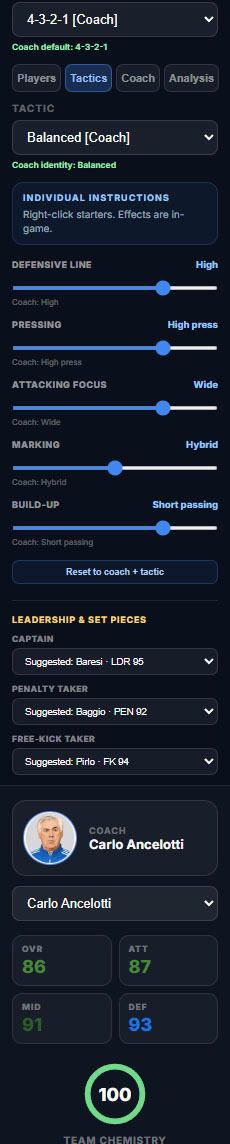
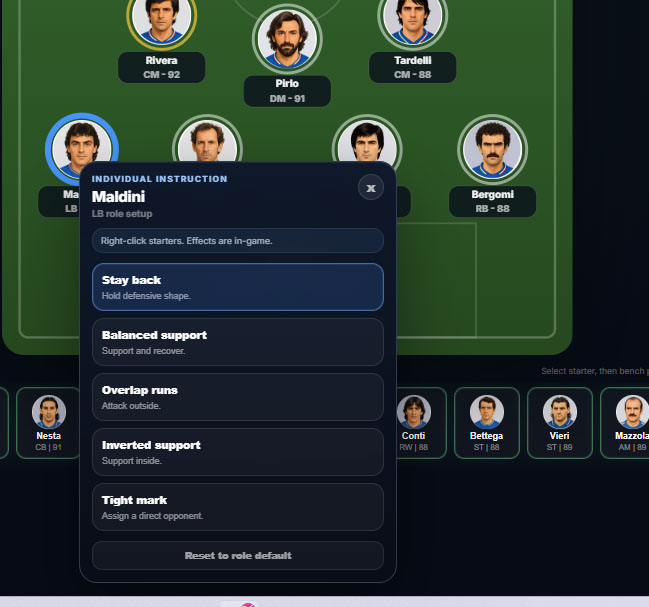
You can watch as a neutral spectator, or take the dugout, for one side, or for both, playing yourself across the pitch. Squad selection, formation, tactical identity, individual instructions: all of it is yours to set before kickoff.
Manager modes now pause between the first and second half. You can change formation, reorder players, make substitutions, revise team tactics and update individual instructions before continuing the same match. Changes during open play remain outside the current version.
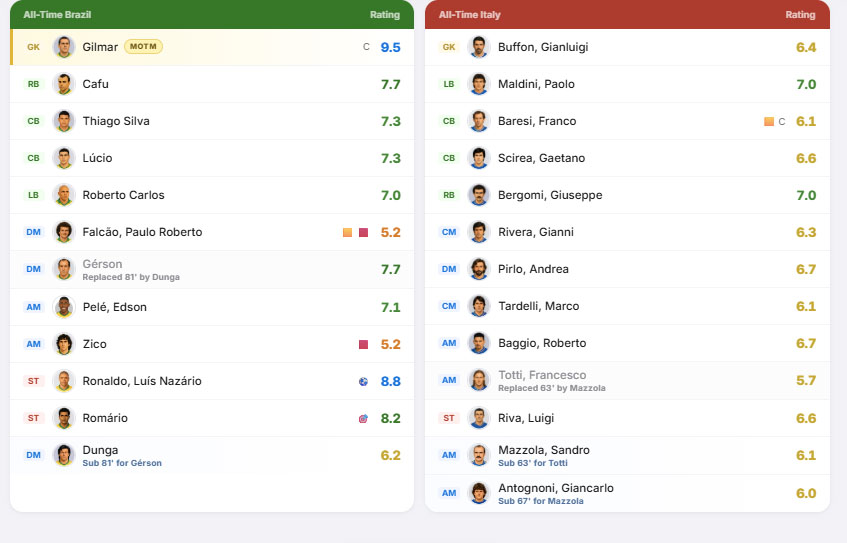
Beyond that, the match plays itself out with everything a real one has: moments of brilliance and moments of chaos, matches that get away from the better side, injuries, controversial calls, the occasional upset that makes no sense on paper and complete sense on the pitch. And for anyone who wants the numbers behind the story, there is a full advanced stats layer, expected goals, key duels, possession patterns, the works.
Nothing Is Cosmetic
This is the part worth repeating, because it is the whole philosophy behind the feature: every option you touch before kickoff has a real, mechanical effect on what happens during the match. Not flavor text. Not a badge on a profile. An actual input into the simulation.
A few examples, deliberately incomplete, because working out the full extent of it is half the fun:
Weather changes rhythm
A technically gifted team built to play the ball along the ground will genuinely struggle to keep its rhythm in a downpour.
Stadiums carry history
A squad stacked with Brazilian legends gets a real morale lift walking out at the Maracanã.
Instructions must fit the player
A brilliant, attack minded full back, if you lock him into a purely defensive brief, a job that leans on marking numbers he was never built for, will visibly struggle, no matter how high his overall rating reads.
The referee matters
A referee who lets the game flow changes how a physical, high tackling team performs compared to one who cards early and often.
Intensity has a cost
A team that presses hard without the legs to sustain it will fade in the final stretch. In Manager Mode, the half-time break is your opportunity to change the approach before that cost becomes decisive.
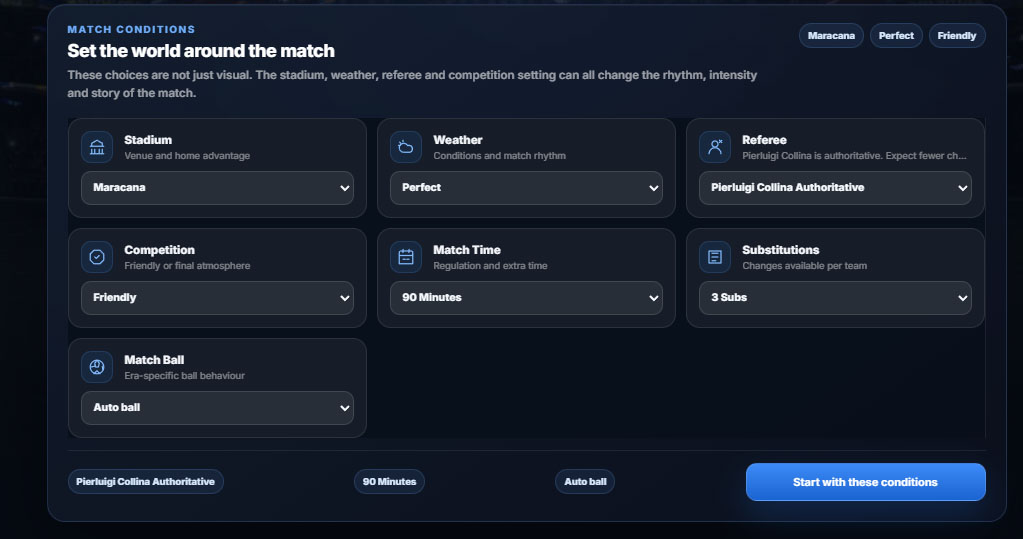
Some teams will handle a given set of conditions far better than others. The same storm, the same referee, the same stadium: different consequences depending on who is on the pitch and how you have set them up. That asymmetry is the point. As in real football, nothing is guaranteed, and the team that "should" win on paper very often does not.
Gelling: Chemistry Isn't a Slider
A team of eleven brilliant individuals is not automatically a brilliant team. That is true in real football and it is true here, which is why gelling exists.
Gelling measures how well a squad actually plays together, and it is built from real football history, not an arbitrary number. Shared nationality matters. Having genuinely played together at an iconic club matters. Belonging to the same footballing era matters. There is more underneath that we are keeping under wraps for now, but the principle is simple: chemistry is earned by history, not assumed by talent.
In practice, this means a "dream XI" assembled purely on stats, five different eras, five different footballing cultures, players who never once shared a dressing room, will often gel worse and underperform relative to a side built with real relationships behind it. A back four that actually defended together for club and country will feel like a unit. A collection of strangers with high ratings will not, no matter how good each of them is on paper.
Pills: The Game Remembers What Actually Happened
Football history is full of partnerships that worked better than the sum of their parts, a strike duo, a midfield trio, a defensive pairing that seemed to read each other's minds. In this simulator, those real world relationships are modeled as Pills: specific, contextual bonuses that activate when the right combination of players and conditions comes together on your team sheet.
There are three tiers. Single Pills reward a specific pairing of players who had genuine chemistry in real football. Department Pills reward a whole unit, a defense, a midfield, that clicked together historically. And then there are Superpills: rebuild an entire legendary team from scratch, correctly, and the engine recognizes it. Not a preset you select from a menu, a team you actually assembled, piece by piece, that happens to match one that made history.
We will not say which pairings, which units, or which teams are wired in. There are a good number already live, and more being added over time. Finding them, and finding out what they actually do to your match, is part of the experience.
Where Luck Fits In
Everything above is deterministic in the sense that it is calculated, not decorative. Weather, gelling, tactics, referees, Pills, all of it genuinely shapes the odds. But odds are not outcomes. Like real football, there is always a margin left to chance: a deflection, a refereeing decision that could have gone either way, a shot that clips the post instead of going in. The simulator is built to be honest about that margin, not to erase it. A better team, better set up, will win far more often than not. It just will not win every single time, because that would not be football.
What to Expect Next
Building this from nothing took months of steady work and hundreds of tests, across every mechanic described here. That is not a complaint, it is context for what this actually is: a foundation, not a finished product.
The Match Simulator is the first real step toward something considerably bigger, arriving over the next several months. If this feature lands the way it is meant to, and that is for you to tell me, everything you are using today is the scaffolding underneath it.
Feedback is genuinely wanted, not just tolerated: what worked, what did not, what felt unfair, what felt exactly right. People who actually love this sport are the only ones who can tell me, honestly, whether I got it right.