
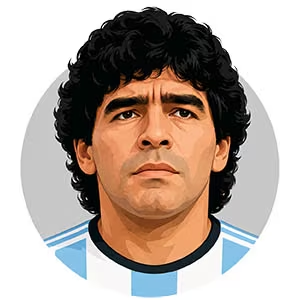
 1976 – 1997Maradona
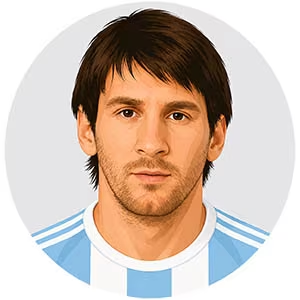 2004 – presentMessi
The question that has no answer — and the one football will never stop asking
Some comparisons in football are debates. This one is a religion. In Italy for decades, siding with Maradona or Messi was not a question of football — it was a question of identity, of generation, of how you understood the game and your own past. On one side stood devotees of the pure gesture, nostalgics of a brilliant, reckless era, people who had grown up watching Diego as the symbol of something larger than sport. On the other stood admirers of numbers, sustained excellence, and an efficiency borrowed from the analytics culture of the NBA. Between them lay a sea of mutual suspicion that seems almost inexplicable outside Italy — because in Spain, England, and even Argentina, the comparison never reached the same mythological intensity.
What follows is not an attempt to settle the debate. The debate cannot be settled. What it is, instead, is a careful dissection of two careers across every meaningful dimension — technique, numbers, peak moments, longevity, leadership, the weight of their nations on their backs — with the honesty to say what the data shows and the humility to acknowledge what numbers cannot capture.
The most obvious premise must come first: we are discussing two of the greatest players in history, two prodigies who may have exceeded even the expectations placed on them at the start of their careers and who shaped, for decades, the very meaning of football worldwide.
Both Argentine. Both number tens. Neither particularly tall. Both left-footed, physically strong despite their size, explosive, balanced, and quick. With a left foot that seems — in both cases — to have been touched by something beyond technique. When talent was distributed, whoever was responsible was clearly generous when forging the left side of these two men.
"They share the same architecture of genius. What separates them is not quality — it is the era in which that quality was expressed, and the shape it was allowed to take."
— Legends Database AnalysisStrictly on technique — ball control, passing, dribbling, shooting — this must be called a draw. Assigning anything less than perfection to either in this department would be absurd. Both may have equals in individual sub-categories, but neither has superiors as complete technical footballers.
A slight edge might be credited to Maradona in the creativity of his shooting — he produced moments of genuinely supernatural improvisation, plays that defied not just defenders but the laws of geometry, enacted with pure instinct and zero hesitation. Messi could produce similar moments, but rarely with the same jaw-dropping unpredictability, the sense that what you just witnessed should not have been possible.
In dribbling, the edge is microscopic. Maradona in his prime was a wrecking ball at low speed and a phantom at high speed — he absorbed contact in a way that suggested his centre of gravity was located several feet underground. Messi, lighter and faster, operated with a different kind of invincibility: the impossibility of stopping him lay not in his physicality but in the speed of his decision-making, the acceleration that collapsed space before defenders could fill it.
Messi has the advantage in numbers — clearly. But the context matters enormously. In Maradona's era, matches were fewer, the game was more defensive, and Serie A in the 1980s was saturated with tactical marking that made individual scoring output almost impossible to compare with the high-tempo, space-rich football of the 2000s and 2010s. Maradona's Napoli years, in particular, were played in a league specifically designed to neutralise his influence.
Despite that, what stands out about Messi is not merely the volume of his goals — extraordinary as that is — but the dual nature of his contribution. He is simultaneously the most dangerous finisher and the most creative provider of his generation. That combination is genuinely unprecedented.
No single number decides this. The comparison must be broken into dimensions — each carrying its own verdict, its own weight, its own truth.
Ball control, dribbling, passing, shooting — both are at absolute peak. Maradona edges in raw improvisation and shooting creativity. Messi edges in decision speed and positional intelligence.
Messi's statistical dominance is undeniable. Even adjusted for era, fewer matches, and defensive football, the gap in goals and assists is real and significant.
Messi's elite-level continuity from 2005 to the present is without precedent. Maradona's career was disrupted by injury, suspension, and the physical toll of playing in a brutal era.
1986 Maradona remains arguably the single greatest individual World Cup performance ever. Messi's 2022 redemption arc was extraordinary — and yet Diego's peak in Mexico may still be the ceiling.
Maradona was a natural-born leader — capable of changing the emotional temperature of a match with a single look. Messi grew into leadership, but it came late and often struggled under pressure of expectation.
Maradona took Napoli — a club never designed to win Serie A — to back-to-back Italian titles. Messi's challenge was to stand out among other generational talents. He did. Diego's challenge was to do everything alone.
Here is what the data cannot show. When Maradona played, the opposing team knew exactly what he was going to do — dribble, hold, create — and they sent two, three, sometimes four players specifically to prevent it. The physical contact in Serie A in the 1980s was extraordinary: brutal, systematic, often violent by modern standards. Maradona played through it, and through it, and through it. His left knee was destroyed. His body was treated with contempt. He kept producing.
Messi, by contrast, was protected more — by the rules of a more sanitised modern game, by the infrastructure of Barcelona, by the teammates who surrounded him. This is not a criticism. Every player operates within their context. But it means that the two careers cannot be placed on the same scale without acknowledging the different weight each was asked to carry.
What the data also cannot capture is the emotional register of each player's genius. Maradona played football as if it were theatre — dramatic, unpredictable, occasionally chaotic, always on the edge. Every match with him felt genuinely dangerous in the best sense: you never knew what might happen. Messi plays as if football were mathematics — logical, precise, devastating. His movements are so efficient they can seem invisible until suddenly they have won the game.
"With Maradona, you watched to see what was possible. With Messi, you watched to see how he would make the impossible look inevitable."
— Legends Database AnalysisBoth descriptions are forms of perfection. They are just different forms.
In terms of pure talent and absolute peak level, the two are essentially tied — a draw that no honest analysis can resolve. But when the comparison widens to cover careers, sustained excellence at the highest level, statistical output adjusted for era, and the ability to define what it means to be the best in the world across two decades, the balance tips toward Messi. It tips — it does not collapse. Maradona remains the more dramatic case: the player who produced the most extraordinary moments, who carried more with less, who played in conditions that would have broken almost anyone else. The fact that he was not the better player across a career is simply a reflection of circumstances — not of what he was capable of when he had the ball at his feet, and the world was watching.