
3
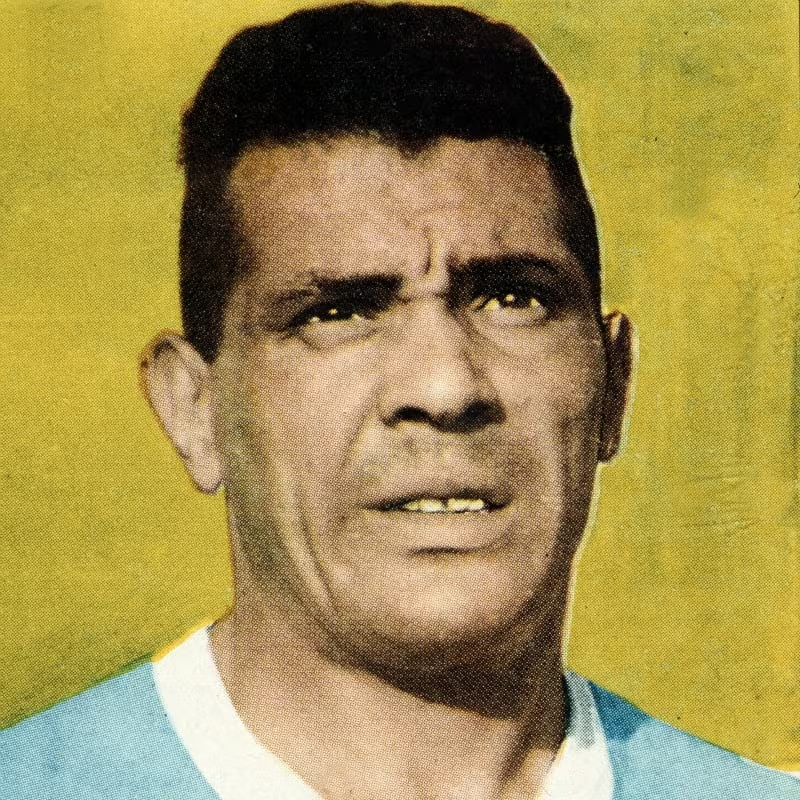
Héctor Scarone
A retrospective Ballon d'Or for the years before it existed. Year by year, from 1900 to 1950, the 51 forgotten football legends who would have lifted it — 1st, 2nd, 3rd, and honourable mentions.
Translator's note. This article is an English translation, edited and adapted by Legends Database, of the original Italian piece "I nostri Palloni d'Oro dal 1900 al 2025" by Niccolò Mello, published on Game of Goals. Part II (1950-2000) is coming next.
A prize that perhaps sparks debate like no other. Partly because of the criteria used to award it. Partly because of the choices themselves. Inevitably. Because in a fluid subject such as football there are no mathematical certainties, and opinions diverge — even more so when rankings of merit are drawn up.
We have set ourselves a very ambitious game: to try to identify the four best players of every year in the 20th and 21st centuries, without limits of nationality or continent, but looking at the entire world. Several parameters have been taken into account: individual and team numbers, achievements, influence in major moments — and, where possible, only from a certain period onwards, watching and analysing matches, because nothing matters as much as performances and what our own eyes can see.
In any case, one must never forget that this is a game, useful more for restoring prestige to somewhat forgotten figures than as a genuine attempt to rank player X above player Y. Also because no one can claim to have a magic wand and know whether, in that specific year, a player certainly deserved first place, third place, or fourth place.
There were years in which the choices were easier, others in which they were very complicated and in which we would have opted for a joint first place. In any case — here are our choices, and that is the end of it.
England, Scotland, Wales and Ireland still own the game. The rest of the world is starting to watch.
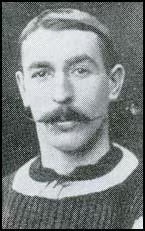
The centre-forward of Aston Villa, a team for which he scored 112 goals in 12 years. The 1899-1900 season was his golden year: his 27 goals, which made him both the league's top scorer and the world's top scorer, allowed the Villans to win the English title.
His brace in the final against Southampton allowed Bury to win the FA Cup, after his goals in the previous rounds had already proved decisive in helping the team advance against Notts County, Sheffield United and Nottingham Forest.
Perhaps the greatest goalkeeper across the turn of the two centuries, in 1900 he made a decisive contribution to the success of the small Aberystwyth Town Football Club in the Welsh Cup against the favourites Druids. He moved to England, where he played for years at a high level with Stoke City, Everton and Sunderland. Having enlisted in the British Army during the Great War, he received a medal of merit for military bravery, but died in battle at Gueudecourt, in France.
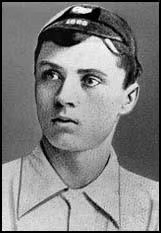
He was the symbolic striker of the decade, an authentic phenomenon with inhuman scoring averages. Five times top scorer in the English league, one of those in 1901 with 23 goals. He was also an infallible marksman for the national team, with 28 goals in 23 matches. A little like Silvio Piola in Italy, he never managed to win a league title.
An inside forward of superior class, he was one of the strongest and most beloved players of the period in Scotland. In 1901 he was the great protagonist of Heart of Midlothian's success in the national cup: driven by Walker's goals and illuminating passes, Hearts defeated the favoured Celtic in the final. That match went down in Scottish history as "Walker's final". His reputation for brilliance crossed Scottish borders: during Hearts' tour of Norway in 1912, Norwegian King Haakon VII insisted at all costs on attending one of his performances.
A goal in every FA Cup match. Including a brace in the final and the decisive goal in the replay. The 1901 FA Cup was Sandy Brown's FA Cup: he led Tottenham Hotspur to the title with his goals. During his spell with Spurs between 1900 and 1902, he scored 28 goals in 46 matches overall: not a bad haul at all.
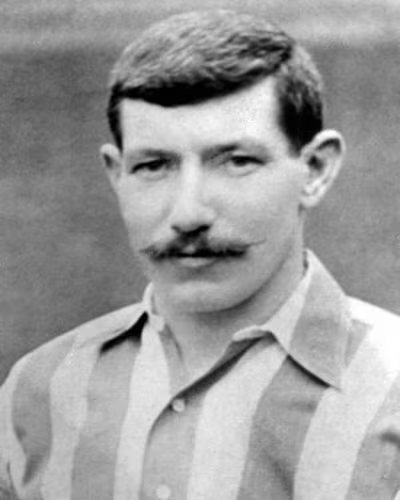
He was called the "prince of half-backs". He mainly played on the right, but in truth he could operate almost anywhere as a driving force of play. Captain and leader of Sheffield United, in 1902 he guided them to FA Cup success, relying on his exceptional charisma. He was also one of the pillars of the England national team.
We leave Great Britain and fly to the Habsburg Empire to meet Johann Studnicka, a forward of Bohemian origin but born in Vienna, who in 1902 stood out with several goals for AC Wiener and for the national team: his was the hat-trick against Hungary in the 5-0 win that marked Austria's debut on the international stage. He was the precursor of the great Austrian and Danubian stars of the following decades: refined dribbling and remarkable technical quality.
The technical and mental leader of Alumni, the first great team of the Argentine championship, in 1902 he became the league's top scorer. His brothers Alfredo, Carlos, Eliseo and Ernesto also played alongside him, as did his cousin Juan Domingo. Temperament, character and unity of purpose were the secrets of his game and of the team's success.
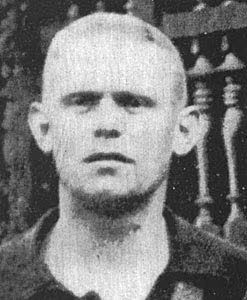
The year of consecration for the Austrian forward: 4 goals in 3 matches for the national team, undisputed protagonist of all his team's successes, from the national championship to the Challenge Cup, the first supranational competition in Europe, contested by teams from the Habsburg Empire.
Liverpool's bomber and the author of a dream year: 32 goals in 34 matches. He scored 67 goals in his first 100 appearances for the Reds, a record only improved in recent times by Mohamed Salah. Originally a right winger, he was moved into the centre of the attack during his Liverpool spell, with devastating results.
He was the great protagonist of Bury's FA Cup success, in the final with the widest winning margin ever: 6-0 against Derby County. Sagar scored one goal and was the extra man in the previous matches as well. In 1905 he moved to the great Manchester United. He also collected two caps for the England national team.
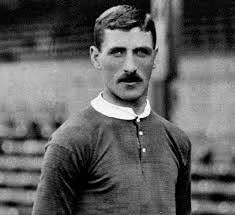
Alongside Steve Bloomer, the strongest footballer of the decade. Class, temperament, longevity and sheer nerve - he even received a one-year suspension for bribing an opponent. He had been the star of Chirk, the team of the Welsh miners, then became the idol first of Manchester City and later of United. He also totalled 48 appearances and 11 goals for the Welsh national team. With him, football moved several years forward, both on and off the pitch. 1904 was one of his best years: 13 goals in 40 matches and the decisive goal in the FA Cup final, which gave City a 1-0 victory over Bolton.
A year to frame for the Rangers Glasgow marksman: his 28 league goals earned him not only the title of top scorer in the Scottish championship, but also in the world, a milestone he had already reached in 1899. Hamilton was a sharpshooter who "saw" the goal like few others: 154 goals in 164 appearances for Rangers, and 15 in 11 for the Scottish national team.
Hamilton in Scotland, and him again in England: for the fifth and final time in his career, he became First Division top scorer with 20 goals, a record that would only be surpassed by Jimmy Greaves.
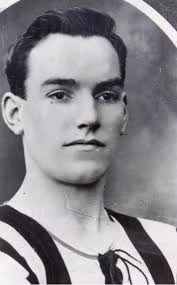
Actor, musician, playwright, producer, conductor, composer. And also a footballer. Not just any footballer. He was the captain and star of the first great Newcastle side: between 1905 and 1910 he won three league titles and one FA Cup, playing mainly as an inside forward, but also as a half-back shielding the defence. The 1904-1905 season in particular was a magical year, with the Magpies crowned champions of England and beaten only by Aston Villa in the cup final. He died of pneumonia in 1939. Even today, many consider him the greatest footballer in Newcastle's history.
From Robert Hamilton to Jimmy Quinn. From Rangers to Celtic. With one common denominator: the instinct for goal. In the 1904-05 season Quinn scored 19 goals, finishing as league top scorer alongside Hamilton, but taking home the championship title, with his Celtic side capable of beating Rangers 2-1 in the title play-off.
The second-highest scorer in Aston Villa history with 242 goals, his first season among the greats - at the age of 20 - brought him victory in the FA Cup final against Newcastle: he scored both goals in the final 2-0 win.
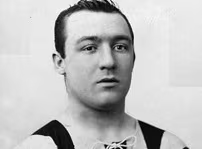
Another extraordinary bomber for first place in 1906. Raised at Bolton, at 21 he exploded with a superb season, scoring 26 goals that earned him the scoring throne in the 1905-1906 First Division. In that same year he made his debut for the national team and for the Football League XI, immediately getting on the scoresheet. He would move to the great Newcastle two years later and win both the league title and the FA Cup.
One of the most solid and consistent half-backs of the period, a mainstay of Liverpool, whom he led to league success. A year to remember, with 41 total matches played by the warrior from Wallacestone.
His 24 goals allowed Liverpool to win the championship: a record-breaking season for the English centre-forward, who was later penalised by an injury that limited him in the following campaign, preventing him from making his debut for the national team.
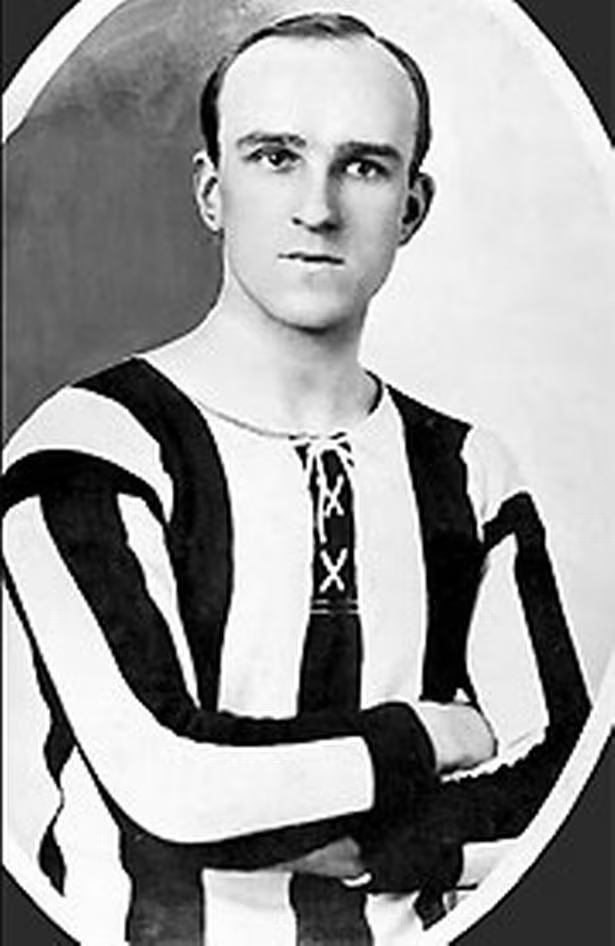
In the all-conquering Newcastle side of those years, he was another star. He was the supreme protagonist of the 1907 title, with a season of 10 goals in 34 appearances: a particularly notable tally for a half-back. He was nicknamed "the Newcastle Flyer", highlighting his surges down the flank, but also his versatility and calmness in handling the most complicated situations. Extremely long-lived, a rarity for those times, he ended his professional career in 1927.
Once again him, and once again a season as an absolute protagonist: 29 league goals, king of the bombers, Celtic champions of Scotland and capable of completing the "double" with the addition of the national cup. It was the highest point of his career.
Before "Dixie" Dean, Everton had already known a great bomber: the Scottish Alex "Sandy" Young, who in 1907 became the league's top scorer with 28 goals, useful in pushing Everton to third place in the championship and to the FA Cup final, lost against Sheffield.
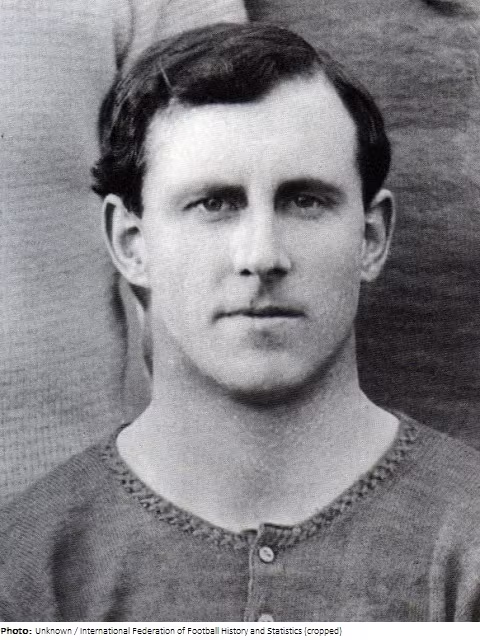
Vivian Woodward is proof that Gianluca Vialli's maxim has been true since the dawn of time: "Goals should be weighed, not counted." That is exactly the case with him. He was not a double-figure machine, nor did he ever maintain the torrential scoring averages of Bloomer, Reybould, Shepherd, or the Scots Hamilton and Quinn. However - immediately after the great Bloomer - he was the most international of them all: because with the national team, he transformed himself. His 29 goals in 23 matches prove it, plus 57 in 24 games for England Amateurs. In that 1908, he did not only contribute to England's Olympic gold at the London Games with a goal in the final against Denmark and 3 in total; he bewitched continental Europe on a tour in which he showed everyone why English football at that moment belonged to another planet compared with everyone else.
The Olympics opened football up to the world and talents began to emerge outside the British Isles: one of them was Sophus Nielsen, a Danish forward who became top scorer at the Games with 11 goals, 10 of which came in a single match, the 17-1 win against France - a record surpassed only by Australia's Archie Thompson in 2011, with 13 goals in Australia-Samoa 31-0. Denmark, also driven by the indomitable spirit of the star Niels Middelboe, reached the silver medal behind the invincible Great Britain.
At 34, he put together a monstrous season, dragging Manchester United - where he had arrived in 1906 - to success in the league and in the FA Cup, with a personal tally of 11 goals in 43 matches. In 1908 the Red Devils also won the first edition of the Charity Shield, defeating QPR in the final.
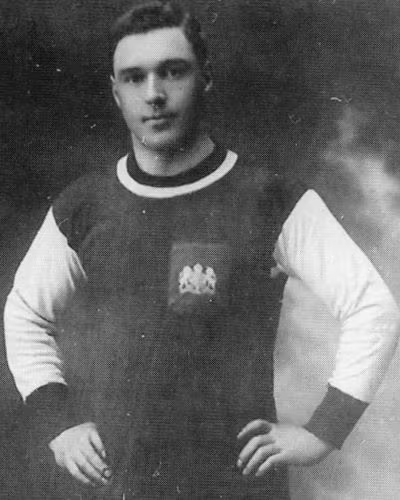
No one until then had ever scored 38 goals in a year: Bert Freeman of Everton, naturally the top scorer of the English First Division, pushed the bar that high. Goals that took his team to second place in the table, beaten only by the usual formidable Newcastle.
Paid handsomely by Newcastle in the summer of 1908, the forward repaid the financial effort with a 15-goal season that carried the Magpies to the title. Shepherd confirmed himself as a punctual penalty-box striker, one of the deadliest of the period.
The Dundee forward lived his year of glory, becoming top scorer of the Scottish championship with 29 goals and making his national team debut at the age of 31. It was the highest point of a career that had also seen him shine in England with Liverpool, Arsenal and Portsmouth.
Hungary, Argentina, Uruguay, Brazil. The first superstars not born in the British Isles take the throne.
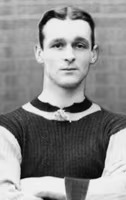
At 25, the Aston Villa centre-forward found his magical year, which brought him gold in 1910 after the bronze of five years earlier: he scored 29 goals in 35 matches, one fewer than top scorer Jack Parkinson, and pushed the Villans to the title, ending a drought that had lasted since the 1899-1900 season.
He scored 30 goals, king of the First Division bombers, but his Liverpool side surrendered by five points to the overwhelming power of Aston Villa. A golden season that also took him to the national team.
Of English origin, his father Alexander had brought football to Argentina. Blood will tell: Arnold, a left winger, led Alumni to the title with a haul of 16 goals and a season that consecrated him among the first high-level players on the South American scene.
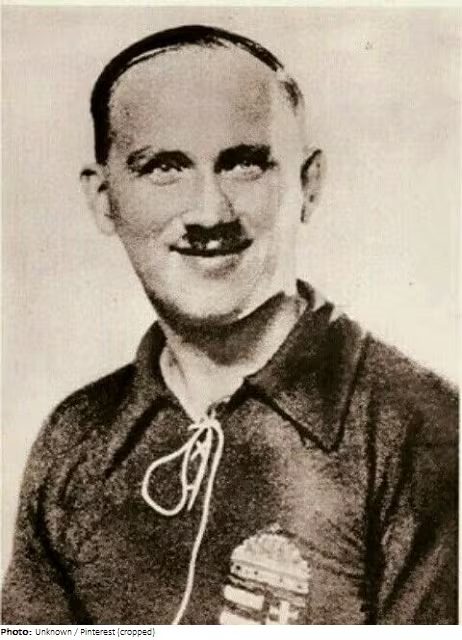
A new decade begins and football enters a new era, taking a quantum leap forward. It does so in the name of the first truly world-class superstar, a player who would not have looked out of place even in later decades: the Hungarian Imre Schlosser, perhaps the greatest number 9 ever produced by Magyar football, despite the competition from the "modern" Kocsis and Albert.
Schlosser starts building momentum at the end of the decade and explodes definitively in 1911: he is the first player on a global scale to break the 40-goal barrier, climbing to 42 and winning the league title with Ferencváros. He will do it twice more. In total, he will win 7 Hungarian league top-scorer titles - a record - with 411 goals. He is even more impressive for the national team: 59 goals in 68 matches between 1906 and 1927, a record later improved by a certain Puskás.
As reliable as a bill of exchange and timeless, stronger than his 36 springs, the Welsh ace has a spectacular year leading Manchester United and drags the Red Devils to the league-and-Charity Shield double. These are the final titles of his career, but not his final flashes: even until after the Great War, his performances will remain at an excellent level.
Top scorer of the First Division with 25 goals, he also scores 8 goals in the FA Cup, but gets injured before the final and, without him, Newcastle surrender to Blackburn. Shepherd confirms himself as the best English centre-forward of the new century alongside Bloomer and Woodward. A sentence in the penalty area.
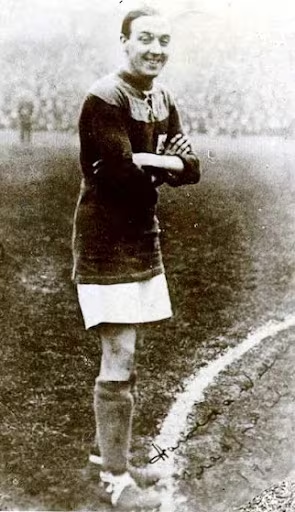
After a 14-goal season at Bristol, he becomes England's hero at the 1912 Stockholm Games: he finishes as the tournament's top scorer with 12 goals, including 4 in the semi-final and one in the final against Denmark, a repeat of the 1908 Games.
As well as being a footballer, Walden also performs admirably in music and cinema: he will act in two films, *The Winning Goal* in 1920 and *Cup-Tie Honeymoon* in 1948.
Had it not been for the Olympic Games, the palm of the best player would still have been his. Another monstrous year with 40 league goals, the Hungarian title with Ferencváros, and a national-team tally that in 1912 alone reads 16 goals - 4 at the Olympics, with Hungary finishing 5th - in 10 matches.
Runner-up top scorer at the Olympics with 10 goals, all scored in the 16-0 win with which his Germany annihilated the Russian Empire, at the end of a season in which he was also a protagonist at home, winning the South German title with Karlsruhe.
He is one of the two Jews - the other is Julius Hirsch - to wear the German national-team shirt. He will have a better fate than his friend: Hirsch will die at Auschwitz in 1944, while Fuchs will manage to escape, taking refuge in Canada, where he will live until his death.
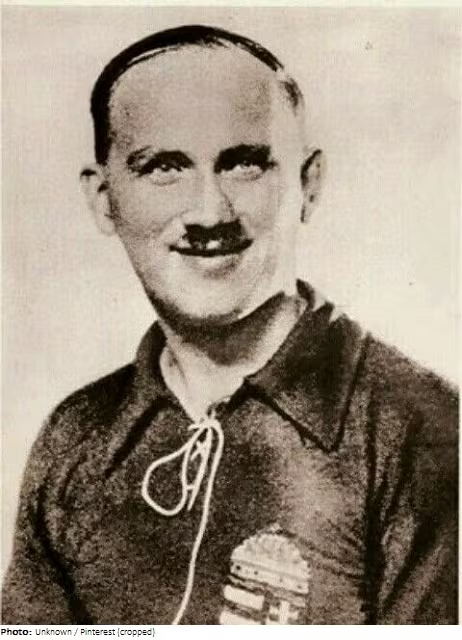
The first player to win the Ballon d'Or twice. And it could hardly be otherwise. Because Schlosser, for the third consecutive year, becomes the world's best goalscorer and, for the third year in a row, exceeds the 40-goal mark: once again 42, bringing him not only another national title, but also the Hungarian Cup, for a historic double.
The level of South American football is rising, and it does so in the name of an authentic superstar: Alberto Ohaco, star of Racing de Avellaneda, the first great team of Argentine football, which becomes known by the nickname "La Academia" because it plays football at a superior technical and qualitative level, teaching lessons to everyone.
Ohaco, who in 1913 wins the league and cup and finishes as top scorer with 20 goals, is the brain of the group: an inside forward who moves through space, with irresistible dribbling, vision of play and goals. Alongside Schlosser, the Uruguayan Piendibene, the Brazilian Friedenreich and the Irishman Gallagher, he is the greatest footballer of the decade. And the fact that none of them is English shows how England is no longer the sole keeper of the footballing gospel. But Her Majesty's subjects will only realise it in 1953.
Tall, slender, and yet immensely strong, a player with extraordinary athletic gifts, so much so that at the time he is also the Danish record holder in the flat 800 metres and the triple jump.
The greatest Danish footballer of the pre-war period and one of the very first greats ever even in absolute terms. After a superb Olympics in 1912, in 1913 he leads his KB to the national title and is signed by Chelsea, where he becomes the first foreign star of the First Division and will play for ten years at the highest level.
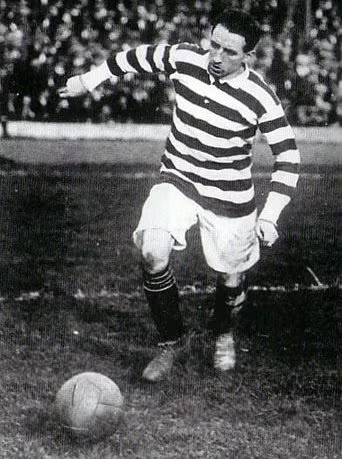
From Ireland comes the prodigy who brings the British Isles into a new era. Dribbling, crosses, goals and class to spare.
He is perhaps the first player for whom insiders - journalists, teammates, opponents - spend words of praise as though no winger of that level could ever again be born in the world. Nicknamed "The Mighty Atom", Gallagher enchants the crowds in a Celtic shirt for 14 seasons, from 1911 to 1925. The 1913-14 season is one of his best: he scores 22 goals and is the absolute protagonist of the league-and-cup "double".
Along the same lines as 1913, Ohaco experiences another great year in 1914: again 20 league goals, another top-scorer title, and another league-and-cup double. Alongside him shines the star of Alberto Marcovecchio, a more classical centre-forward with whom Ohaco combines to perfection.
A slight downsizing compared with the three prodigious previous years, but Schlosser still lives great moments in 1914. He remains the world's top scorer with an overall tally of 36 goals, while he scores 21 goals in the 1913-14 championship. That, however, does not end with the league title, as his Ferencváros is beaten to it by MTK Budapest.
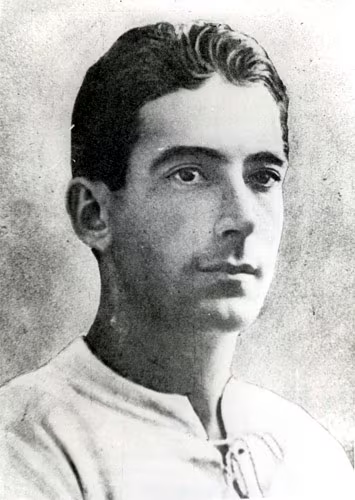
After two Silver Ballons, the long-awaited first place finally arrives. At the end of a magnificent championship, crowned by another Argentine title, to which Ohaco contributes by scoring the beauty of 31 goals: needless to say, he is also the top scorer. He is at the peak of his career and seems ready to take centre stage for the national team too, with the imminent arrival of the Copa América.
His career is interrupted by the Great War just when it was about to take off. Also because, when he returns, he breaks a leg and is never the same again. In 1914-15, at the age of 24, he takes home the English title with Everton and the scorers' chart with 32 goals. Cyclonic.
He is the father of all La Liga goalscorers. His nickname "Pichichi" will later become the name given to the top scorers of the Spanish championship.
He is a star of Athletic Bilbao, at that time the best team in Spain, even though there is not yet a single-round-robin tournament able to truly establish it. In 1915 he nonetheless personally contributes to the Basques' success both in the Northern Championship and in the Spanish Cup, with a hat-trick in the 5-0 that annihilates Espanyol in the final.
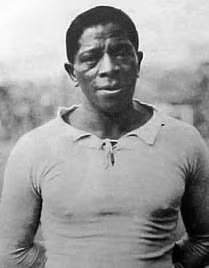
Uruguay bursts onto the world stage, and does so in the name of boys of colour. Something shocking for the time, but also the reflection of a society already very advanced in social terms and in rights for everyone.
Gradín, a Black athlete like his teammate Delgado, is the crack of the team that wins the first edition of the Copa América, fooling the favoured Argentina - a classic that will often repeat itself. Already the South American record holder in the flat 200 and 400 metres, he makes speed his greatest weapon. When he wins the South American Championship with 4 goals and the title of best player, he is only 19. He seems destined for a luminous career, which will, however, be less brilliant than could reasonably have been expected.
With Europe halted by the Great War, South American football monopolises the scene. Among the great protagonists of the "Celeste's" success in the Copa América is also him, José Piendibene, the strongest Uruguayan footballer of the period.
A cerebral forward, who starts from the central position and then drops back to distribute the ball and organise the move, he is perhaps the first successful example in South America of the so-called "withdrawn centre-forward".
A pillar of Nacional Montevideo, which in 1916 takes home the national title, he is one of the strongest half-backs of the period in South America. From the following year he will begin to decline and will suffer from it to such an extent that he takes his own life: he will do it at night, shooting himself in the temple in the centre circle, in his beloved "Parque Central".
A heartbreaking story, from another time, which should not be condemned but understood, and which testifies to a man's visceral love for the club of his heart.
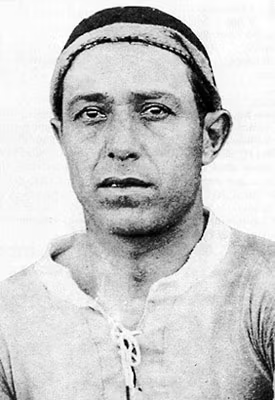
Uruguay again, this time in the name of a superb and complete winger, a born winner. Nicknamed "El Loco", the madman, because of his volcanic character, he plays for Uruguay until 1927 and wins the Copa América 6 times - a record - and the 1924 Olympics, as well as 8 national titles with Nacional Montevideo.
In 1917 he is 24 and experiences his moment of glory: he is the chief driving force of Nacional, which takes home the Uruguayan title and the Copa Newton, while in the victorious Copa América he finishes as top scorer.
He returns to the forefront with another prodigious season: having moved to MTK Budapest, he immediately wins the championship, scoring 38 goals. MTK is a machine: 21 wins, zero draws and only one defeat, 113 goals scored, and an attack made up of Schlosser, Alfréd Schaffer and Kálmán Konrád that is devastating. The best club team in Europe, if not the world.
In Uruguay's second consecutive Copa América triumph, a 19-year-old appears on the scene, destined to change forever the history and geography of Uruguayan football. His name is Hector Scarone, and in that 1917, which marks his explosion among the greats, he scores 15 league goals and adds two gems in the Copa América - the second decisive in beating Argentina in the decisive clash - which also allow him to snatch from teammate Romano the palm of best player of the tournament.
MTK in 1917-18 even manages to improve: one more point in the league, 43 to 42, still 21 wins, but with one draw and zero defeats. Perfection. And Alfréd Schaffer replaces Schlosser as king of the bombers with 42 goals, beating his teammate, who stops at 41.
Schaffer, who also totals 17 goals in 15 matches for Hungary, will in the following years move through several clubs in Switzerland, Germany, Austria and Czechoslovakia. As a coach he will win the league title with Roma in 1941-42, but will die in 1945 in Germany, where he is coaching Bayern Munich, under the bombings.
Beaten at the finish by his teammate Schaffer, he has to "settle" for a Silver Ballon, but he once again confirms himself at the top of the wave. He is the greatest footballer the world has known up to this moment: a centre-forward who scores avalanches of goals in any context and is capable of shifting the balance of a team.
It is no coincidence that MTK Budapest replaced Ferencváros as the dominator of the Hungarian scene precisely when he moved there.
Brazilian football launches "The Tiger" into orbit. German mother and Black father, before stepping onto the pitch he has to straighten the curly hair typical of mulattos in order to be allowed to play. Off the pitch he is discriminated against because of racism, but on the pitch the end justifies the means.
Credited with 1,239 goals in 26 years of career - although the official ones are less than half - he is Brazil's first world-class superstar. In 1918 he wins the Paulista championship with Paulistano, finishing as top scorer with 20 goals.
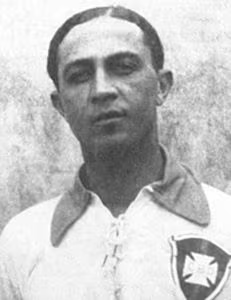
He is once again top scorer of the Paulista championship with 20 goals. And he is once again state champion. But that is not really what projects him into first place. It is the success in the Copa América, where he is the main protagonist: he scores 4 goals, is the tournament's top scorer alongside his teammate Neco, and is named best player.
A deserved award that he receives after scoring the decisive goal in the play-off against Uruguay. It happens, incredibly, in the 122nd minute of play, in the longest match in history, resolved by a decisive strike from "The Tiger".
Another championship dominated by MTK, who concede three draws and one defeat, but still take home the title with great ease. And Schaffer does not disappoint: he scores 41, one fewer than the previous year. Now he is the new main attacking outlet of the Magyars.
Supporting the sensational scoring vein of the Schaffer-Schlosser duo is him: a winger and playmaker, a superb player with a velvet touch and irresistible bursts. Probably the strongest footballer of Jewish origin in history.
He will move to Austria and become Sindelar's master. To escape Nazism he will take refuge in Sweden. Playing alongside him is also his brother Jenő, who is much less gifted as a player but will be superior as a coach, winning a Mitropa Cup in charge of Austria Vienna. Jenő will later flee to the United States during the war.
Olympic gold in Paris and Amsterdam, Copa Américas, Héctor Scarone. The Río de la Plata becomes the new capital of football.
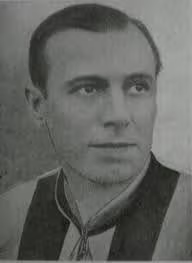
After a few placements, at the age of 30 comes the deserved first place. In 1920 he leads Uruguay to success in the Copa América - the third of Piendibene's career - and is elected best player.
As already mentioned, he is a decidedly atypical forward, more an advanced playmaker than a mere finisher. Discovered by Juan Harley, the tactical father of Uruguayan football, he is highly regarded throughout South America. Even the great Argentine rivals in those years consider him the best footballer in the world.
One of the greatest foreigners in Milan's history: from 1910 to 1917, in the Rossoneri shirt, he puts together something like 97 goals in 88 matches, despite not even being a classic centre-forward, but rather an all-round forward, also capable of operating out wide.
In 1920 he is one of the great protagonists of Belgium's surprise Olympic gold, in the final against the favoured Czechoslovakia. The Bohemian side goes 2-0 down in the final after two disputed goals and is reduced to 10 men in the 40th minute after Steiner's sending-off: at that point they withdraw and also lose the silver medal.
At 19 he wins the Copa del Rey with Barcelona; in the summer he makes his debut at the Olympics and drags the Red Fury to a sensational silver medal, taking advantage of Czechoslovakia's disqualification.
A natural talent, instinctive saves, often with the opposite hand, overwhelming personality, regal sense of positioning. He is destined not only to dominate the decade in his role, but also to revolutionise it in a unique way.
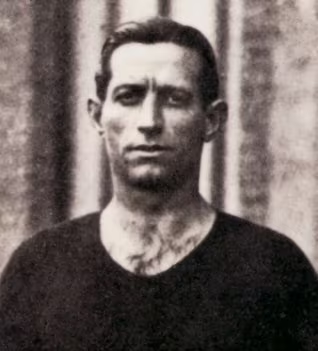
Quick, technical and deadly. He made Argentina great and then Italy too, where he won a league title with Torino as top scorer and formed a trio of wonders with Baloncieri and Rossetti.
1921 consecrated him on the international stage at just 20 years of age: with Newell's Old Boys he won the Copa Ibarguren and the Copa Nicasio Vila; with the national team he took home the Copa América as top scorer, Argentina's first after several failed attempts. It was also his goal that was needed to beat Uruguay in the final decisive match.
Another lavish scoring year for the Brazilian bomber, who scored 35 goals in the Paulista championship, his career best. The following year Friedenreich would win the Copa América again, but would never take the field: the Brazilian president Epitácio Pessoa in fact banned players of colour from taking part in the tournament, a reflection of the rampant racism that at the time lurked within the South American country.
One of the greatest goalkeepers in the history of Argentine football. Nicknamed "La Gloria", he was the supreme guardian of Boca Juniors between the 1910s and the 1920s, and with the Xeneizes he won 5 league titles.
In the 1921 Copa América, together with Libonatti, he was the great protagonist of Argentina's victory, keeping his goal unbeaten in every match. He would experience another moment of fame in the 1924 Copa América, when he saved everything in the match against Uruguay - 0-0 - and was carried in triumph by the Uruguayan fans themselves as recognition of his brilliance.
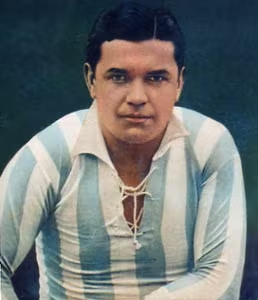
Together with Friedenreich and Scarone, probably the strongest footballer of the first half of the 1920s. Powerful, technical, an implacable finisher, but also an unsuspected assist man. For years, he was the principal bogeyman of Argentine and South American defences.
In 1922 he was a hurricane; he simply could not be stopped: 55 (!) goals in 40 league matches, which obviously earned his Independiente the national title.
An inside forward with a refined touch and broad vision of play, in the early 1920s he was considered one of the best players in Europe, if not at times the number one. His career would be abruptly interrupted at the age of 26 after a treacherous challenge by an Austrian defender, Tandler, in an international match.
In 1922 he took home the Hungarian championship with MTK Budapest for the third consecutive year, and for the third consecutive year he was top scorer.
Together with Orth, in the early 1920s he was considered the best European player, the fulcrum of the formidable Sparta Prague - not coincidentally called Iron Sparta - which in 1922 won the championship by winning every match.
Of that team, where the bomber Antonín Janda also shone, Pešek-Kada was the technical and mental leader. He would play two Olympics with Czechoslovakia, in 1920 and 1924. Also at the 1920 Games, he was part of the national hockey team as well, proof of truly remarkable versatility.
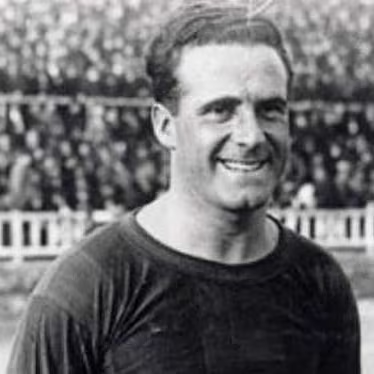
His landing on the world stage brought football into a new era. If the 1910s saw the arrival of superstars from outside the British Isles, the 1920s witnessed the birth of the first true phenomenon, one of the greatest ever: Héctor Scarone.
No one had yet seen a player do with the ball what he was capable of doing. His technical repertoire was boundless: natural talent, ball control, dribbling, shooting, personality, consistency and the ability to make a sensational impact in the decisive moments.
He was the Messi of the 1920s, a global superstar before whom everyone bowed and whom everyone covered with praise - from Meazza to Zamora, from Bernabéu to Monti, all the way to South American insiders.
In 1923 he won the Uruguayan championship - he would eventually string together eight - with 35 goals in 26 matches, to which he added his second Copa América success leading the "Celeste".
An elegant and technical forward, a rarity in English football, used as it was to powerful number 9s who got straight to the point. Raised at Arsenal, he moved to Sunderland in 1911 and won the league in 1913.
In 1923, at the age of 32, he experienced his magical moment, taking his team once again to within a step of the title - second behind Liverpool - and becoming First Division top scorer with 30 goals. He seemed finished, but at 34 he accepted a new move to Arsenal and would be fundamental, as a centre-half, to the planning of the great team devised by Herbert Chapman, the one that would change football.
Power, speed and goal instinct: he is considered one of the greatest players in the history of Boca Juniors and was the idol of José Manuel Moreno, the future enormous superstar of Argentine football.
In 1923 he contributed to the Xeneizes' league success with a 40-goal season and the title of top scorer.
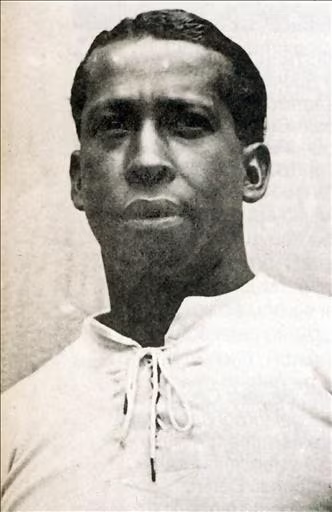
From Scarone to Andrade, the other great phenomenon of Uruguayan football in the decade who rises to the top of the world. At 23, Uruguay's coloured player became the star of the Paris Olympics, the first great global-style showcase of the football circus, which carried the small South American nation to gold.
Andrade was a Metodo wing-half - in modern terms, an attacking full-back - who did not limit himself to closing down the opposing left winger, but built the play and pushed along the entire flank. In Paris he enchanted everyone with a series of fabulous performances, and people renamed him "The Black Wonder".
A cursed genius - off the pitch he indulged freely in beautiful women, alcohol and vices of every kind - he would die poor and in misery.
Fast and powerful, with goals always loaded in the chamber. He is "Artilhero" Petrone, the bomber of Uruguay's Invincibles. Nasazzi the charismatic leader, Andrade the tireless piston, Scarone the creator of play and him the implacable finisher: a legendary quartet.
At the Paris Olympics he finished as the tournament's top scorer with 7 goals. And not content with that, in the Copa América played between October and November - and won, for a change, by his Uruguay - he again conquered the scorers' chart and the award for best player.
Another outstanding season for "The Magician", one of his many nicknames along with "the Gardel of football" and simply "El mejor jugador del mundo": 32 league goals, once again champion of Uruguay, great protagonist both in the victorious Copa América and at the Paris Olympics, where he scored 5 goals.
Three Uruguayan players in the top three places: the Celeste dominated those years without any possibility of reply.
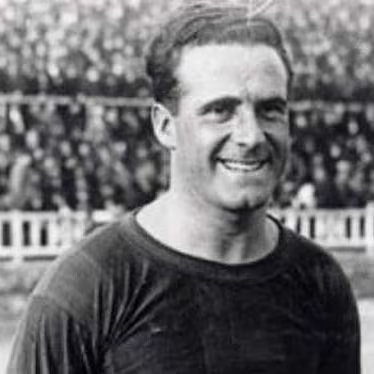
Perhaps the best year of the Uruguayan phenomenon's career, as he won his second Ballon d'Or, drawing level with Imre Schlosser: in the league he reached the disarming figure of 46 goals in 26 matches.
His Nacional, which formed the backbone of the Celeste, went on a European tour in which it offered spectacle and victories. Scarone was the absolute star and scored 29 goals in 38 matches, enchanting both the public and critics of the Old Continent. Barcelona convinced him to stay.
Uruguay had Scarone; Argentina answered with Seoane. He too, in 1925, took part in a European tour with Boca Juniors and scored 16 goals.
In addition, he dragged Argentina almost single-handedly to success in the Copa América - although on that occasion it was without the champions of Uruguay: Seoane literally took the stage, scoring 6 goals and also winning the award for best player.
A decidedly little-known name among football aficionados. Inevitably so, because the player, born in Glasgow but naturalised American, spent his entire career in America.
Why does he deserve the lowest step of the podium in 1925? Because in the shirt of Bethlehem Steel he scored 67 league goals, and although the United States was on the periphery of football, it is still a record that remains unbeaten today. Across the whole year he reached 70: in this case the record would first be improved by Josef Bican in 1944 with 76, then by Gerd Müller in 1972 with 85, and finally by Leo Messi in 2012 with 91.
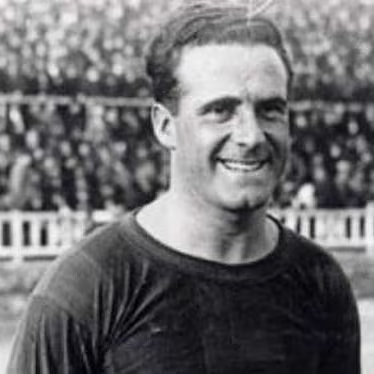
Universally recognised as the best footballer in the world, Scarone lived another year worthy of applause. He moved to Barcelona, scored 6 goals in 9 official matches and won the Copa del Rey.
The Blaugrana club wanted to turn him into one of the first professional players, building around him and Samitier a team without rivals in Europe: the club therefore offered him a pharaonic salary, but Scarone refused. Because if he became a professional, he would have had to give up forever the possibility of playing the 1928 Olympics with Uruguay - at the time the highest football competition in the world - open only to amateur athletes, who were still almost the totality.
Scarone therefore returned to Uruguay and finished the season with Nacional, scraping together 15 goals in 20 matches. The cherry on top of his year was the Copa América: he scored 5 goals and dragged Uruguay to another triumph. In our survey he wins his third Ballon d'Or, moving clear of Imre Schlosser, stuck at two.
"The Gazelle", that was his nickname. The first idol of Avvocato Gianni Agnelli, the first great foreigner in the history of Juventus.
He arrived in black and white from Hungary in the summer of 1925, at the age of 23. His first season, 1925/26, which earns him our Silver Ballon, is a marvel: he scores 37 goals in 26 matches and leads Juve to the Italian title. The second year is more troubled, though still seasoned with 15 goals in 17 matches. Then he returns home.
His presence is inevitable too: the long-distance challenge between him and Scarone for the palm of best footballer on the planet is the first great duel on a global scale, also fuelled by the perpetual Uruguay vs Argentina comparison.
In this season Seoane wins the national title again with his Independiente, finishing as top scorer with 29 goals.
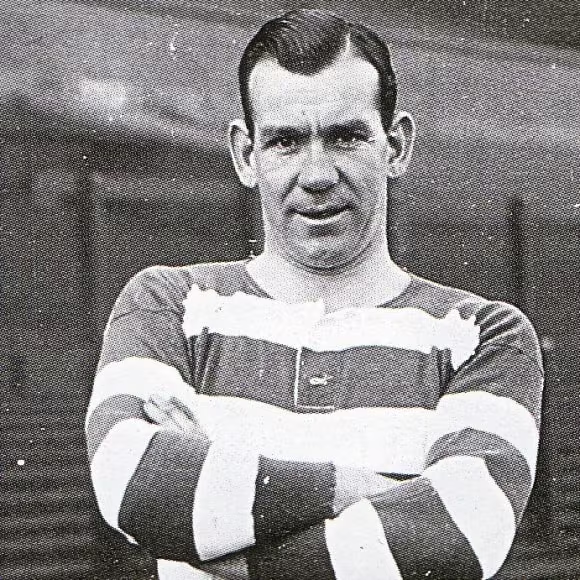
The long South American dominance, which had lasted since 1918, is interrupted by a powerful 23-year-old Scottish centre-forward. No one in British football will score more goals: 550.
Extremely strong in the air, a born opportunist, McGrory leaves no escape in the penalty area. He is the first in Europe to break the 50-goal barrier for two consecutive years. The 1926-27 season sees him consecrate himself at the highest level: 48 league goals, 59 in total, and with Celtic he wins the league-and-national-cup "double".
It is Scottish dominance. While McGrory updates the record books in Scotland, in England another Scottish bomber, Hughie Gallagher, 25, dominates.
At Newcastle he produces a dream year, 39 goals in 41 appearances, and leads the Magpies to the title. He will score 100 club goals with the English club, becoming an undisputed idol. His post-football life will not be so fortunate: he will lose his wife to cancer and die by suicide.
In continental Europe the Mitropa Cup - or Central European Cup - is born, the ancestor of the European Cup, bringing together every year the best club sides from the Central European countries. From 1929, Italy would also take part.
The first edition is won by Sparta Prague, which still features some survivors of the extraordinary team that dominated the early 1920s, including the star Karel Pešek-Kád'a, but also relies on new aces. Above all Josef Silný, a complete forward who can do everything and who drags the Prague side to the title with 5 goals, also earning himself the crown of king of the bombers.
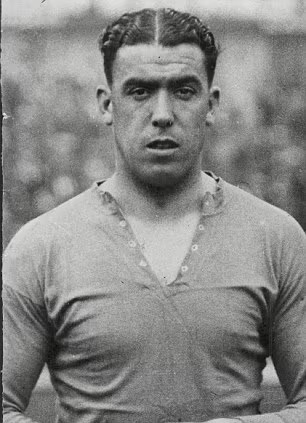
England discovers not a centre-forward, but the centre-forward, the greatest in its history: William "Dixie" Dean, an authentic myth even today, almost a century later.
Everton paid handsomely to sign him from Tranmere Rovers in 1925, when "Dixie" was only 18, and reaped the dividends: at 21 the centre-forward had already passed the threshold of 100 First Division goals, a record. He would score 310 in total, third all-time behind Jimmy Greaves with 357 and Steve Bloomer with 314, but with a better goal average than both: 0.86 compared with Greaves' 0.69 and Bloomer's 0.59.
The 1927-28 season saw Dean go beyond every limit: he scored 60 league goals in 39 appearances and, obviously, Everton won the title.
Back in his homeland, the Magician arrived polished to perfection at the 1928 Amsterdam Games and kept his promise: he dragged Uruguay to a second consecutive Olympic gold at the end of a competition in which, like a diesel engine, he started slowly but warmed up as he went along.
Best on the pitch in the extremely hard semi-final against Italy, best on the pitch in the final - the replay after the 1-1 of the first match, in which he was absent through injury - against the arch-rivals of Argentina. First he provided the assist for Figueroa's goal, then he took matters into his own hands and scored the decisive goal with an incredible shot from the edge of the box.
Two years later he would complete the circle, at 32, by winning the first FIFA World Cup in history, and would spend the final scraps of a legendary career in Italy: one year at Inter and two at Palermo.
Call it a treble ante litteram. That is what Ferencváros achieved in Europe in the 1927-28 season. They won the league, the national cup and the Mitropa Cup.
And their extra man was József Takács, a sort of Inter-style Milito of 2009-10. Takács finished as top scorer of the Magyar First Division with 31 goals and top scorer of the Mitropa with the beauty of 10 goals, three of which came in the first-leg final against Rapid Vienna, which ended 7-1 and made the return match in Austria superfluous - for the record, it ended 5-3 to the Austrians.
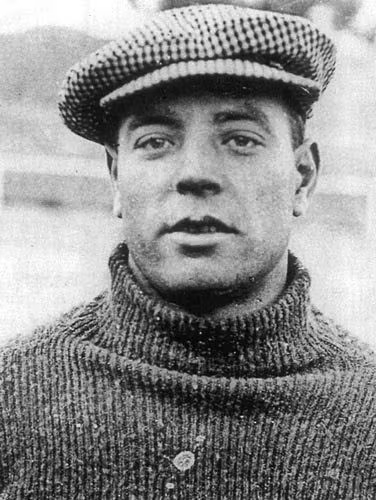
History is written. A goalkeeper, the "Divine" Zamora, wins the Ballon d'Or, and to reach such a milestone an extraordinary season is needed. That is exactly the season produced by the 28-year-old Spaniard, probably, together with Scarone and our own Meazza, the greatest footballer of the pre-war era.
Zamora, as already explained, revolutionised the role of goalkeeper, which thanks to him entered the modern age: coming off his line, diving saves, shouting at teammates, command of the area.
They say he had mesmeric qualities and hypnotised forwards - including Meazza, who in official matches would never manage to score against him. In reality, Zamora's qualities were the result of sensational reflexes and a unique sense of positioning.
Raised at Barcelona, he moved to Espanyol in 1922 and to Real Madrid in 1930, paid his weight in gold and becoming Spain's first professional footballer.
In 1929 he won the Catalan Cup and the Copa del Rey with Espanyol and, above all, stopped the English in a friendly that made history: Spain became the first national team to defeat the masters, winning 4-3, and it did so thanks to Zamora. Small detail: during the match the goalkeeper broke his sternum, but continued playing and, despite the pain, saved his goal several times with extraordinary saves.
Technical leader of Estudiantes de La Plata, the team of the "Professors" - so called because on the pitch they gave lessons to everyone - Manuel Ferreira was an atypical forward.
A little like Piendibene had been in Uruguay, a little like Pedernera would be in the 1940s, he liked to start from the central position, drop back to set up the play or drift out onto the wings. The fulcrum of Argentina, which in 1928 won Olympic silver behind Uruguay, in 1929 he became captain of the Albiceleste and took home the Copa América, complete with the award for best player.
At the World Cup the following year, Ferreira would again be the reference point of the Argentine national team, which however would once again finish second behind the opponents of a lifetime.
Italian football begins to move closer to the giants of Europe and South America. After Baloncieri's 4th place - the supreme playmaker of Torino, who in 1928 won the league title with 31 goals and led Italy to Olympic bronze - 1929 sees Angelo Schiavio reach the highest level.
The Bologna bomber scores 29 in 29 matches, finishing as championship top scorer and champion of Italy leading his Bologna. The Emilian side would continue to dominate - under the sign of Schiavio, but not only - the early 1930s, also taking home two editions of the Mitropa Cup.
Meazza, Sindelar, Sárosi. Italy, Austria, Hungary, Czechoslovakia. The Mitropa Cup is the de facto Champions League.
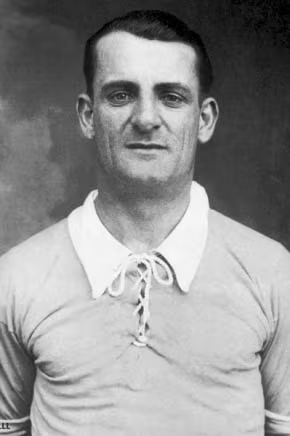
From a goalkeeper to a defender: Uruguay's charismatic leader José Nasazzi. A Metodo full-back - in modern terms, a centre-back - Nasazzi was the most consistent Uruguayan player and the one who offered the best performance in the 1930 world-title success.
One single blemish, in the final against Argentina, when he let the Argentine centre-forward Guillermo Stábile get away for the temporary 1-1 goal. But it was the only stain in a final that Uruguay turned around above all thanks to him, to his shouts urging on his teammates, to his prodigious recoveries, to his regal sense of positioning.
If Andrade is the symbol of the 1924 Olympic gold and Scarone of the 1928 Olympic gold, Nasazzi is the emblem of the 1930 triumph.
The world witnesses the birth of a new phenomenon, Scarone's natural heir in completeness of resources and technical qualities, the absolute dominator of the 1930s.
Scarone is precisely Meazza's idol, and between the two there is also a sort of passing of the torch, given that for one season - 1931-32 - the old master and the young pupil are teammates at Inter.
At 20, Meazza produces an outrageous season, missing out on gold only because the most important football competition is born, the World Cup, and it is inevitable to reward those who shine in that context. The 20-year-old Peppìn makes himself noticed at home with a year of 31 goals in 33 matches, top-scorer title and league title with Ambrosiana Inter.
On international soil he wins the Mitropa Cup scorers' chart, while for the national team he scores 6 goals in his first 5 appearances, including a fabulous hat-trick against Hungary in the International Cup, which gives the Azzurri victory in the competition, the forerunner of the modern European Championship.
The lungs and brain of Rapid Vienna, who in 1930 win everything: champions of Austria and Europe, after defeating Raimond Braine's Sparta Prague in the Mitropa Cup final.
Smistik is decisive in the second-leg final also from a scoring perspective, because one of his goals limits the defeat to 3-2 and allows the Austrians to grab the title after the 2-0 victory achieved in the first leg.
The centre-half would also be one of the main protagonists of Hugo Meisl's Wunderteam, which enchanted the continent in the early 1930s.
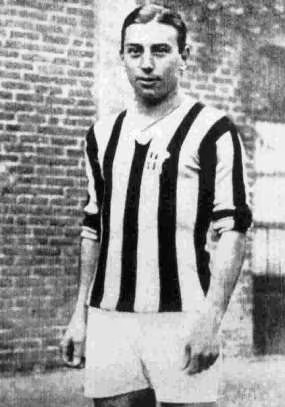
Already a major protagonist in Argentina, particularly at the 1928 Olympics where he shone at the highest level, Raimundo "Mumo" Orsi moved to Italy, paid his weight in gold by Juventus.
And in black and white he enchanted: 5 consecutive league titles, the genius and recklessness of a very strong team that formed the golden backbone of Vittorio Pozzo's national side. A left winger with unstoppable dribbling, a specialist in shots directly from corner kicks, Orsi in 1930-31 produced a sensational season also in terms of scoring, reaching the remarkable figure of 20 goals, a notable haul for a wide forward. Goals that became fundamental in dragging Juve to the Italian title.
Leader of Chapman's great Arsenal, which won the first English championship in its history. A team that dominated the 1930s in England - eventually taking home a total of 5 league titles and 2 FA Cups - but did not limit itself to results: it completely revolutionised the way of occupying the pitch.
The credit goes to its manager, Herbert Chapman, who, to counter the offside rule, invented a new system: the full-backs, from central players without marking duties, moved wide onto the wingers; the centre-half dropped back onto their line and became the fulcrum of the department by marking the opposing centre-forward; the wing-halves were moved into the middle to control the two inside forwards.
From the 2-3-2-3 of the Metodo, football moved to the 3-2-2-3 of the WM, with midfield becoming the new key sector of the manoeuvre. The Scot Alex James, a former forward, was brought by Chapman to pull the strings of the game on the midfield line, a sort of pre-war Schiaffino or Inter-era Suárez. From that position he refined the play, dropped into defence, launched attacks and supplied assists to the forwards.
He is somewhat the Italian Alex James, because although Ferrari plays in the Metodo, his characteristics are more those of a shuttle midfielder and playmaker than of the Metodo inside forward who operates very close to goal.
A player capable of doing everything, in the 1930-31 championship he scored 16 goals and was decisive for Juventus' title. Perhaps more appreciated abroad than at home, he is one of the secrets of Pozzo's two-time world champion Italy and a figure today somewhat underrated. His honours list is boundless: 8 league titles with three different teams - in addition to the 5 with Juventus, he won 2 with Inter and one with Bologna - 2 Coppe Italia, 2 World Cups, and one International Cup.
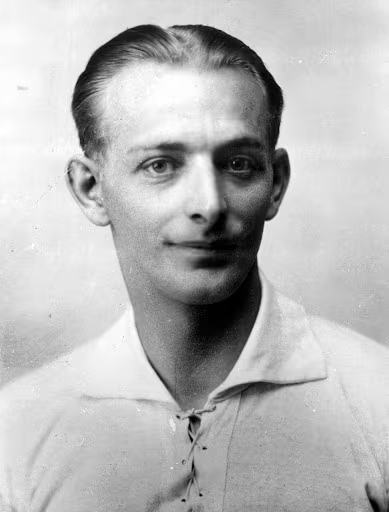
Meazza's great rival in European football during the 1930s. A duel that reflected the different views of the Italian and Austrian schools: on one side, Italian pragmatism and concreteness; on the other, the refinement and aesthetics of the former masters of the Habsburg Empire.
Sindelar, called the "Mozart of Goals" and "Paper Man" because of his slender build and sinuous movements, was the star of Hugo Meisl's great Austria.
In 1932, at 29, he produced an exceptional season, leading Austria to triumph in the International Cup with 4 goals in 5 matches. Also in 1932, he played perhaps the finest match of his career, scoring a sensational hat-trick in the 8-2 with which the Wunderteam humiliated highly rated Hungary.
Nicknamed "La Fiera", he was a centre-forward of inhuman power and sensational scoring averages. In the Argentine championship he would score something like 206 goals in 197 matches, winning three league titles, all with River Plate.
The first, in 1931-32, was also the most electrifying because Ferreyra put away 43 goals (!). His experience with the national team was less fortunate, with just one goal in 4 appearances.
Another monstrous season for the English king of goals. His Everton were sensationally relegated to the Second Division in 1930; he immediately brought them back to the First Division and in 1931-32 led them to another powerful league triumph.
Victory, obviously, under the sign of Dean, who reached 45 goals in 38 matches. We are not at the 60 of 1928, but we are not very far away.
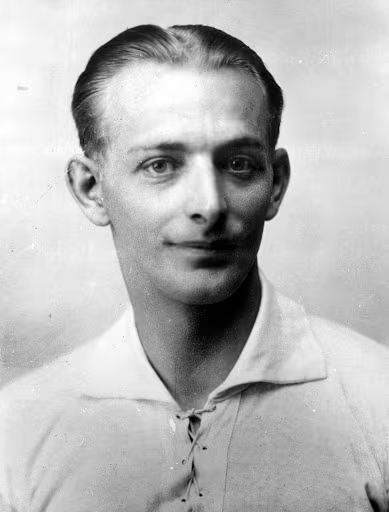
From the International Cup to the Mitropa Cup: Sindelar dominated the early 1930s at European level from the height of sumptuous performances and took home the most coveted club competition of the Old Continent leading Austria Vienna.
After demolishing the Juventus of Orsi and Ferrari in the semi-final - in the first leg, which ended 3-0, he scored a brace, making the 1-1 return leg irrelevant - in the final he won the long-distance duel with Meazza's Ambrosiana Inter.
The first leg saw a 2-1 victory for the home Nerazzurri, with Sindelar providing the assist for his team's goal. In the return leg, "Paper Man" rose as the undisputed protagonist and scored all three goals in the final 3-1.
Having moved to Real Madrid in 1930 and been paid his weight in gold by the Blancos, "the Divine" won the Spanish championship in 1932 and 1933, producing two sensational seasons: in the first season he conceded only 15 goals, in the second 17, confirming not only the exceptional qualities of the Merengue back line - with the Ciriaco-Quincoces duo - but also of Zamora, who comfortably won the award for best goalkeeper.
He was a superstar recognised as such all over the world, the only goalkeeper whose fame in the Old Continent was equal to that of the best forwards, from Meazza to Sindelar, from Orsi to Braine.
A spectacular left winger, gifted with remarkable dribbling and shooting quality, one of the stars of the wonderful Arsenal of the period.
At 21, in 1932-33, he experienced a record-breaking year, scoring as many as 33 goals and guiding the Gunners to the second title in their history. It was a season to frame for Arsenal, who scored no fewer than 118 goals in 42 matches, expressing an attacking, powerful and modern brand of football.
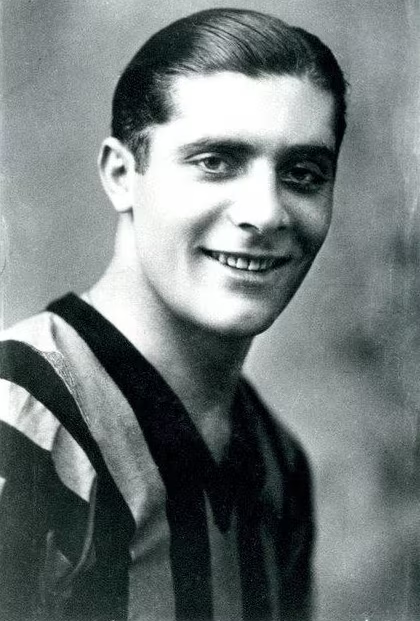
Italy organised the World Cup and won it. The symbolic man of the Azzurri could only be him: Giuseppe Meazza. At 24, he was by now a mature and established champion, a leader.
After yet another double-double season with Ambrosiana Inter - 21 league goals - "Il Balilla", who with the national team does not play as a centre-forward as he does for his club but as an inside forward, a man devoted to the final pass, takes the sceptre on the world stage.
Goal against the United States in the round of 16, goal against Spain in the quarter-finals, then he works behind the scenes to craft the disputed and hard-fought victories over Austria and Czechoslovakia that bring Italy to triumph.
After bronze in 1932, here comes silver in 1934. Meazza & Ferrari, the most extraordinary pair in the history of Italian football, the Messi and Iniesta of the 1930s, complemented each other wonderfully: genius and rationality, flair and method, speed and tactical sagacity. Formidable individually and unreachable as a tandem.
It is on their union and understanding that Pozzo built Italy's two-time world champion side. In the 1933-34 season Ferrari won yet another league title in a Juventus shirt with 16 goals and played a great World Cup, scoring two goals himself and directing traffic with impeccable mastery.
The greatest centre-half in the history of the Metodo, "doble ancho" as they call him in Argentina, because of a physique that was anything but lean.
A long-lived and winning career, the keystone of the Argentina side that finished Olympic runner-up in 1928 and world runner-up in 1930, he was signed by Juve when he seemed to be on the wane. Instead, he became a black-and-white pillar, a solid and tough marker as well as the first organiser of the play.
Naturalised Italian, Pozzo turned him into the defensive pivot of the Azzurri at the 1934 World Cup. By fair means and foul, he kept the bogeyman Sindelar under control in the fiercely contested semi-final against Austria, earning himself a place under the spotlight too.
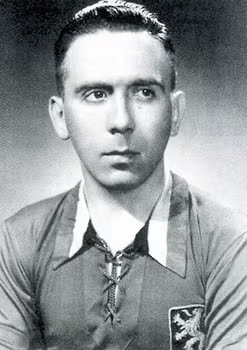
Another fabulous champion of the 1930s. A player capable of doing everything, an inside forward of superior class, a forward with an innate nose for goal.
The first professional player from his country, paid his weight in gold by Sparta Prague, he became a crack in Czechoslovakia, winning two championships and two top-scorer titles.
1935 consecrated him at the highest level in Europe: with 7 goals, including 3 in the final - one in the first leg and two in the return leg - he dragged the Prague side to success in the Mitropa Cup final against Ferencváros.
Italy has Meazza. Austria has Sindelar. Hungary has Sárosi. Three countries, three schools, three phenomena.
Of them all, he is the most universal: he can play extremely well as a centre-half, as an inside forward and as a forward. He spends his entire career at Ferencváros and in 1935 he consecrates himself at the highest level: he loses the Mitropa Cup final against Sparta Prague, but consoles himself with the top-scorer title of the competition.
And he also wins the scorers' chart in the International Cup, where however his Hungary finishes third behind Italy and Austria.
Italy is in its golden period and produces champions in a continuous stream: the latest comes from Robbio Lomellina, a town in the Pavia plain, although his family is from Vercelli. His name is Silvio Piola.
Tall, loose-limbed, yet gifted in terms of fundamentals and acrobatic play. In 1935, at 23, he takes the stage: he closes the season with 21 goals in Serie A for Lazio, Pozzo calls him up to the national team because of an injury to Meazza, and on his debut at the Prater in Vienna against the very strong Austria he scores the two goals that allow Italy to win the International Cup. Predestined.
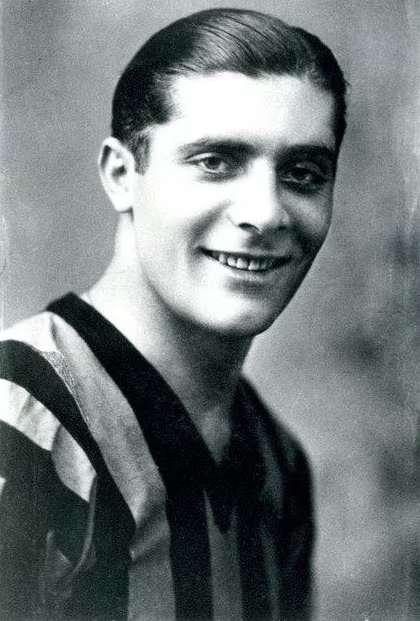
Second Ballon d'Or in three years. Because even if he wins nothing at club level, Meazza's 1936 is worthy of applause: top scorer in Serie A for the second time with 25 goals, top scorer in the Mitropa Cup - where his Ambrosiana is eliminated in the semi-final by Sparta Prague - with as many as 10 goals.
And there is a strong sensation that, despite dense internal and external competition - Ferrari, Braine, Sindelar, Piola, Sárosi, James, Lángara, Leônidas da Silva - the strongest footballer in Europe, and in the world, is him.
In the Austrian championship he operates almost more as a playmaker, limiting himself to scoring just 8 goals. Domestically, he still takes home a national cup.
But it is at international level that he explodes: runner-up top scorer in the Mitropa with 8 goals, he leads his Austria Vienna to a second triumph after a fiercely contested final against holders Sparta Prague, thus winning the direct duel with Braine.
Spain's Piola. A centre-forward with goals in his blood, he is credited in his career with more than 900 unofficial goals.
Top scorer in three countries - Spain, Argentina and Mexico - and also a protagonist with the Iberian national team, with the exceptional record of 17 goals in 12 matches, in 1936 he wins the Pichichi title of La Liga for the third consecutive time with 27 goals, pushing his Oviedo to third place behind Athletic Bilbao and Real Madrid.
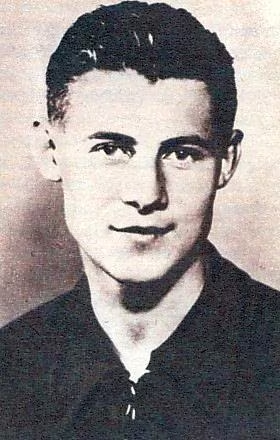
1937 was unforgettable for the Hungarian champion: leading Ferencváros, he finally won the Mitropa Cup title, at the end of a crazy final against Silvio Piola's Lazio in which Sárosi dominated.
In the first leg, which ended 4-2 for the Magyars, the Ferencváros superstar scored a hat-trick. In the return leg Sárosi added two more in the pyrotechnic 5-4 that delivered the cup to his team.
In total, he was the competition's top scorer with 12 goals. Sárosi was also an enormous protagonist with the national team: in an 8-3 against Czechoslovakia, a match valid for the International Cup, he scored 7 (!) goals, probably touching the highest point of his career.
The world witnesses the birth of a new centre-forward with unreal goal averages. It is the Paraguayan Arsenio Erico, who plays in Argentina for Independiente.
At 22, in 1937, he scores something like 47 league goals - obviously finishing as top scorer - in 34 matches. Clever, technical, fast, opportunistic, Erico will become the all-time top goalscorer of the Argentine Primera División with 293 goals.
His first Serie A top-scorer title with 21 goals. Piola comes close to the league title with his Lazio - three points behind Bologna - and finishes second in the European campaign in the Mitropa Cup: stopping the Biancocelesti one step from the dream is Sárosi's Ferencváros.
Piola is also runner-up top scorer in the tournament with 10 goals, always behind his Hungarian rival. A serious and rigorous athlete, extremely long-lived and capable of playing at excellent levels until 1953-54, Piola is still today the all-time leading scorer in Serie A with a total of 290 goals.
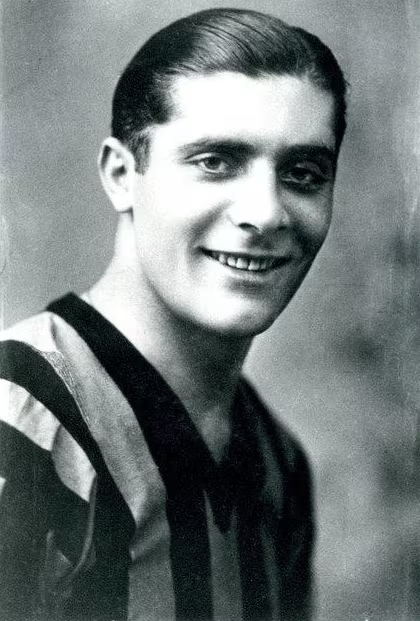
Meazza too, like his idol Scarone, wins the Ballon d'Or for the third time, and the milestone is no accident, given that they are the two greatest footballers of the pre-war era.
For "Il Balilla", another magical year: champion of Italy for the second time with his Inter after the 1929-30 title, Serie A top scorer with 20 goals, splendid protagonist - probably even more in terms of performances than in 1934 - of Italy's second world title in France.
A success that the Azzurri seize by force in a climate made fiery by the policies of Benito Mussolini's fascist regime. Pozzo's team, however, is simply too superior on the pitch for any opponent. After some initial suffering against Norway, it is a Rossinian crescendo: France, Brazil and Hungary are beaten on full merit, and Meazza, with 5 assists and one goal, is the architect of the triumph.
Europeans had admired him live at the 1934 World Cup, when however his Brazil was eliminated in the round of 16 by the Spain of Zamora and Lángara.
Four years later Leônidas takes the stage again, and he is no longer a bit-part player. At 25 he consecrates himself as one of the best footballers in the world. He becomes top scorer of the World Cup with 7 goals, and his absence in the semi-final against Italy is decisive for the elimination of the South American national team on the road to the final.
Already very well known in Brazil, he comes from highly productive scoring seasons with Bonsucesso, São Cristóvão, Peñarol, Vasco da Gama, Botafogo and Flamengo. The best, however, is still to come.
Hungarian champion with Ferencváros, top scorer of the International Cup at the moment of the wartime interruption, runner-up in the Mitropa Cup behind Josef Bican's Slavia Prague, 1938 sees Sárosi shine greatly at the World Cup.
Five goals in total, at least one in every match, and second place behind Italy. In the final, the Azzurri are too full of confidence even for a very strong Hungary, which alongside him fields Gyula Zsengellér in attack, another deadly finisher.
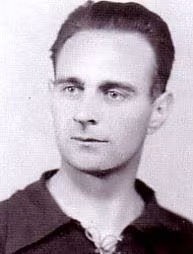
Nicknamed the "Paganini of football", Zsengellér at 24 experiences a prodigious and unrepeatable year, both individually and as part of a team, after having already been a protagonist at the 1938 World Cup with 5 goals.
In 1939 he leads Újpest to the national title by scoring 56 goals in 26 matches, 4 short of Dean's European record from 1928 and 11 short of the world record set by the American Stark in 1925.
The cherry on top is victory in the Mitropa Cup: Zsengellér scores 9 times in 6 appearances, wins the scorers' chart here too and naturally crowns Újpest champions. His career seems destined to take off, but partly because of the war and partly because of a decline of his own, he will never again manage to repeat the levels of that 1939.
For the third consecutive championship, the Independiente centre-forward reaches sidereal heights, with an overall tally of 40 goals after the 47 of 1937 and the 43 of 1938.
Goals that allow the Argentine side to win the title for two consecutive years and score a total of 218 goals: no team in Argentina will ever again reach such scoring figures. Erico will continue to score a great deal in the following years too, despite a serious injury affecting his performances. He will be the idol of Alfredo Di Stéfano.
The first great champion of Peruvian football, in 1939 he experiences a simply perfect year: to the national title with Universitario he adds success in the Copa América - the first for Peru, which will have to wait until 1975 to repeat the triumph - complete with the award for best player and the top-scorer title with 7 goals.
Argentine and Brazilian golden ages, the Grande Torino, the rise of Puskás and Di Stéfano. Then the most shocking final ever.
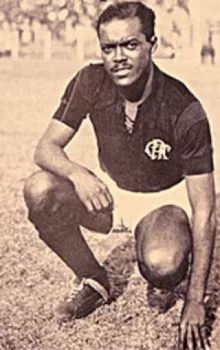
"Leônidas' goals were so beautiful that even the opposing goalkeeper would get back up to congratulate him."
So wrote Eduardo Galeano to sketch the figure of the Brazilian centre-forward, a true marvel in terms of technical quality and acrobatic gifts.
Leônidas in 1940 is 27 and at his peak: he scores 51 goals in the season, 30 of them in the Carioca championship with Flamengo, which earns him the top-scorer title.
He has become famous in recent times because the RSSSF - the federation of football history and statistics - attributes to him the record for official career goals. But it is a debated record, since it is impossible to count goals with absolute certainty before a specific historical period.
Goal more, goal less, in any case the substance does not change: Bican is someone who scored tons of goals wherever he played. A rising star of Austrian football at the 1934 World Cup - where he scored against France in the round of 16 - he fled to Czechoslovakia to avoid the Anschluss and dragged Slavia Prague to success in the 1938 Mitropa Cup, finishing as top scorer with 10 goals.
The 1940s see him shine at the highest level; unfortunately, the war gets in the way and prevents him from being launched into the international arena: in 1940 he scores 50 league goals, wins the national title, and 56 in total.
After winning the scorers' chart three times in Spain, Lángara flies to Argentina, to San Lorenzo, to escape Franco's dictatorship - he is a republican.
And on his first attempt he finishes as top scorer with a haul of 33 goals. His arrival brings spectacle, and the club members rise in a short time from 15,000 to 35,000, making San Lorenzo a very popular club.
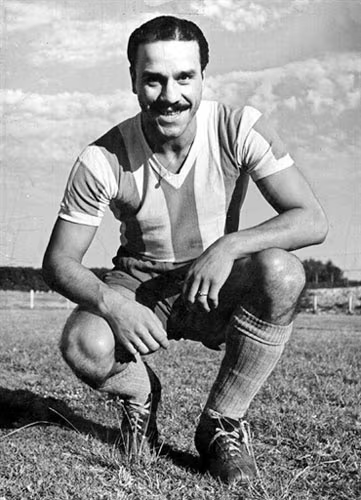
Scarone in the 1920s, Meazza in the 1930s, him in the 1940s: one symbolic player for each decade.
The god of football endowed José Manuel Moreno with every possible resource: he was an absolute genius, with phenomenal ball control, technically perhaps the greatest footballer ever seen up to that point. For some Argentine historians, he is not inferior to Maradona and Messi - not considering Di Stéfano truly Argentine.
Moreno with the ball literally does whatever he wants. He is the technical leader of the River Plate side that goes down in history with the nickname *La Máquina*, the most iconic and celebrated team in the entire history of Argentine football.
Having exploded at the end of the 1930s and immediately become a popular icon, in 1941 Moreno is 25 and takes home the Argentine championship and the Copa América, where with 3 goals and classy plays he dominates the competition.
Another prodigy of Central European football, he is nicknamed "Bimbo" because of the gentle features of his face, in contrast with his athletic power. Compared with Bican, two years younger, Binder is a more classical striker, a battering ram, but both are united by an extraordinary scoring vein.
It is a pity that Austria was never able to field a front three with them and Sindelar inventing behind them: opponents would have suffered very badly indeed. Naturalised German after the Anschluss, in 1941 he drags his Rapid Vienna to a historic feat, winning - the only Austrian team ever to do so - the Gauliga, the unified German championship.
In the final in Berlin against the very strong Schalke 04, Rapid go 3-0 down and Binder misses a penalty in the first half. In the second half comes the craziest of comebacks, with Binder redeeming himself and scoring three goals in the final 4-3 victory for his side.
In the River Plate and Argentina sides that put on a show and win everything in 1941, he is the other side of the coin. Two years younger than Moreno, the two complement each other perfectly: the other is the creative genius, he is the tactical genius.
He starts as a centre-forward, but in reality plays twenty metres behind the most advanced line, orchestrating the threads of play thanks to superior tactical intelligence and vision. He will be the great master of Di Stéfano, whom he will inspire not only at River but also in Colombia, at Millonarios of Bogotá.
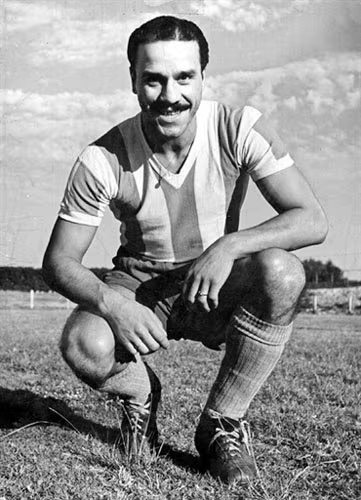
Now consecrated at the highest level, Moreno in 1942 continues to offer spectacle, dragging River Plate to victory in the championship and playing a superb Copa América: he is top scorer with 7 goals, but in the final decisive match his class is not enough and the Albiceleste must surrender to little Uruguay, who unexpectedly win the title.
The 5 goals he scores against Ecuador in the final 12-0 nevertheless represent a record still unmatched today in a Copa América match.
Keystone of the Uruguayan national team, Obdulio at 25 rehearses the Maracanaço that eight years later will deliver him and the Celeste to legend.
Against the favoured Argentina in the final decisive match of the Copa América, he leads Uruguay to a sensational 1-0 triumph thanks to Bibiano Zapirain's strike. The extra man is Varela, who plays a superb competition and a superb match, so much so that he is elected best player.
After 1941, he confirms himself at an extremely high level both domestically and for the national team, reaching 23 league goals despite his inclination to organise play more than to finish it. Only one goal scored instead in the Copa América.
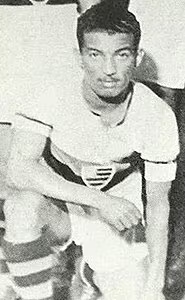
Brazil's answer to Moreno. An inside forward with boundless vision and frightening technical resources, at 21 Zizinho establishes himself as the new phenomenon of Brazilian football, dragging Flamengo to success in the Rio championship with 13 goals and a myriad of assists, repeating the title won the previous year.
"O Mestre Ziza", as he is nicknamed, is the bridge between the generation of Leônidas and the winning one of the 1950s. His career will be extremely long-lived, and he will play at a high level until almost the age of 40.
Having moved to São Paulo, Leônidas immediately becomes the standout protagonist of the Paulista title with an overall year of 50 goals. It is the beginning of a particularly fruitful marriage between the Brazilian centre-forward and the club, with 5 championships in 7 seasons.
If there is one universal player in the history of Italian football, it is Valentino Mazzola. The captain of the Grande Torino, in his first year in the granata shirt, confirms his extraordinary qualities as a tireless piston and an attacking midfielder capable of doing everything.
He scores 11 goals in Serie A, 5 in the Coppa Italia and leads Toro to the historic double. The Granata had not won the Italian title since 1928; with Valentino in command, they begin an unrepeatable cycle that will reach its peak after the war.
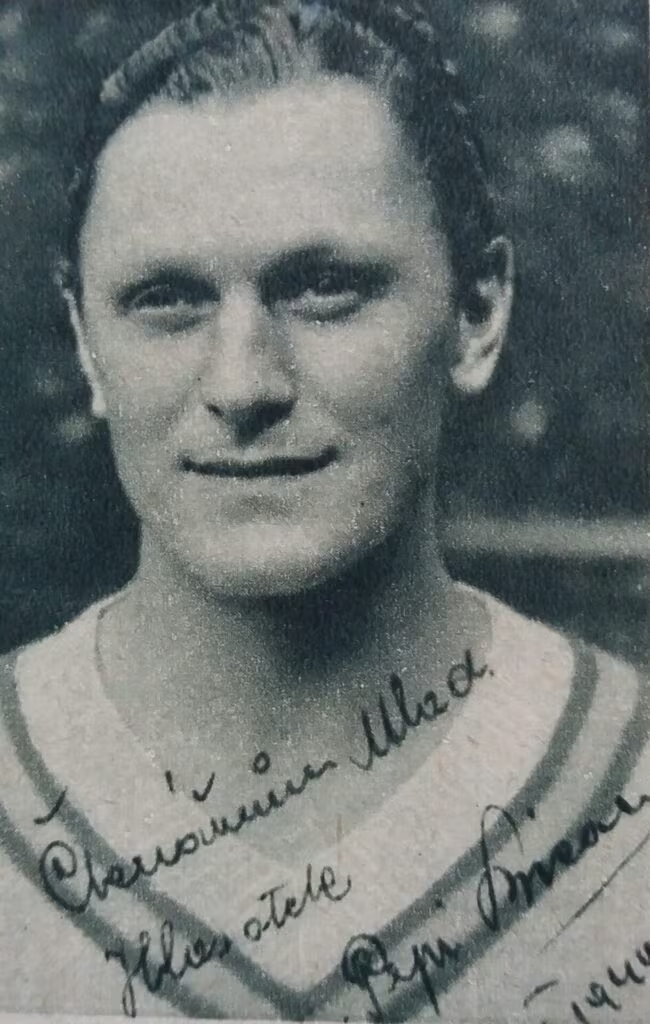
The king of goals reaches his apogee, putting together a monstrous season with Slavia Prague: 57 goals in 26 matches. He also scores 19 in the national cup, for a total of 76 goals in 32 matches, more than 2 per game (!).
It is something unique and unreal in the history of the game, a record still unbeaten today: Messi in the 2011-12 season would reach 73 between club and national team. The Argentine, however, holds the record for goals in a calendar year: in 2012 alone he would reach 91.
Another Rio title and another outstanding championship with 13 goals and a series of fabulous plays. At 22, he is now the new star of Brazilian football, ready to carry the national team on his shoulders in a decade that, for Brazil, must mark the arrival at the summit of world football.
One of Spain's greatest goalscorers, the greatest in Valencia's history: with his club he wins La Liga three times and the Copa del Rey twice.
1944 is his year of glory: he wins the league title and finishes as top scorer in the Spanish championship with 27 goals.
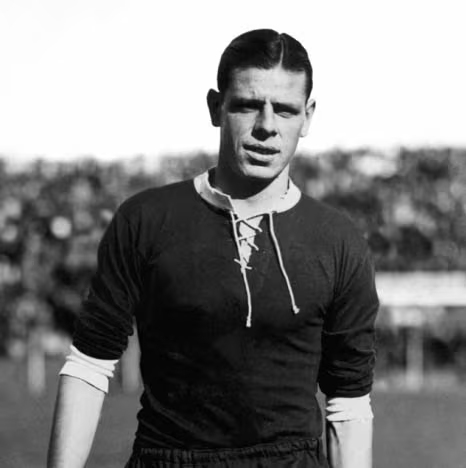
Another extraordinary phenomenon of Argentine football: after having been, with Erico, the keystone of the marvellous Independiente of the late 1930s, Sastre is signed by São Paulo in 1942.
And so, after having supplied as an all-action inside forward for the deadly Paraguayan finisher, he does the same with another sumptuous prince of goals, Leônidas. But Sastre - who in his career manages to play in 8 different roles, always with a high level of performance - does not forget how to score: in his first year at São Paulo he scores 18 goals. In 1944 he reaches 16.
But his best season is probably the third: 17 goals in 40 matches, despite no longer playing as an attacking inside forward but rather as a volante in front of the defence. A true total weapon.
In a Brazil footballistically in love with the refined science of Zizinho, the idea of an opposite kind of footballer begins to take shape. Heleno de Freitas is athletic, physical, powerful, a pure-bred goalscorer with a great extra-sporting culture - he discusses philosophy and reads Dostoevsky - and on the pitch he is a lion who never holds anything back.
Leader of Botafogo, in 1945, at 25, he wins the Copa Roca with Brazil and comes close to victory in the Copa América: but his 6 total goals - which earn him the top-scorer title jointly with the Argentine Norberto "Tucho" Méndez - are not enough for Brazil, who finish second, one point behind Argentina.
In 1955 he will fall ill with syphilis and be found dead at 39.
Between Moreno and Pedernera, there is room for him: "El Feo". He is the left inside forward of that dream River Plate side, but in reality he is the player who, by exploiting the Diagonal system, ends up as the most advanced man in the attacking line.
His 293 goals in the Argentine championship prove it, making him joint top scorer with Arsenio Erico. In 1945 Labruna wins the national title and finishes as top scorer with 27 goals. He will play until the age of 40, even taking part in the unfortunate 1958 World Cup. With River he will win 9 championships in total and will be Sívori's master.
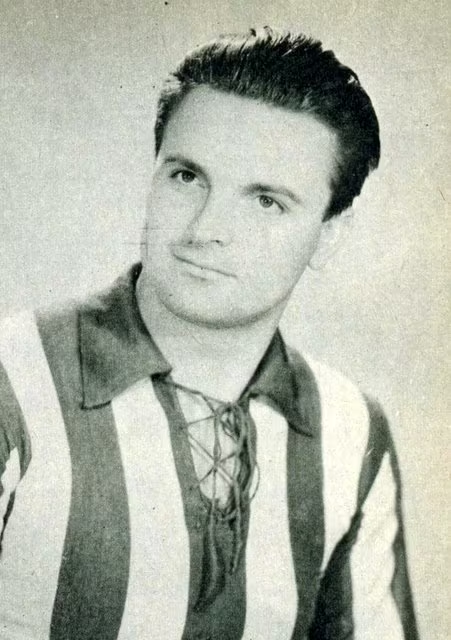
After the days of Sárosi and Zsengellér, Hungarian football comes back into fashion. And it does so with a powerful centre-forward and inhuman scoring averages.
Ferenc "Bamba" Deák, so nicknamed because, like a bamboo cane, he seems to sway through the folds of the match before suddenly delivering the decisive thrust. In the first season after the war, with little Szentlőrinci, he scores something like 66 goals in 34 rounds!
It is the new record of European football, beating Dean's previous mark of 60 in 1928, and falling just one short of the American Stark's 1925 record.
The final season in Argentina for "El Maestro", who moves to Millonarios in Colombia, paid a fortune in dollars.
But it is with the national team that he gives his best: in the Argentina side that, for the third time in the last four editions, wins the Copa América, he is the absolute protagonist, so much so that he is elected best player of the competition.
In addition to his two goals in the final stages, Pedernera confirms himself as the engine of the Albiceleste's play, a team that disintegrates the competition by scoring 17 goals in 5 matches.
A fairy-tale trio, the one formed by Farro, Pontoni and Martino - the "Terceto de Oro" - drags San Lorenzo to success in the 1946 Argentine championship after a sensational comeback over Boca Juniors.
Pontoni is the principal bomber with 20 goals: in his three years at San Lorenzo he will reach 66. Extremely strong in the air, tactically intelligent, he refines his technique through hard training, eventually earning himself a place in the Argentina national team that also wins the Copa América that summer. He is Pope Bergoglio's idol.
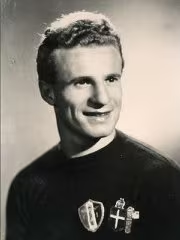
After the war, the Grande Torino becomes Italy's star, the team that, with its spectacular and innovative football - in some ways anticipating that of the great Hungary and Cruyff's Holland - makes Italians forget the horrors of the conflict.
The technical and charismatic leader is Valentino Mazzola. In the 1946-47 season, Toro wins the league title with 63 points and 104 goals scored. Mazzola, an authentic universal joker, scores 29 and is the championship's top scorer.
He also sets an astonishing record: in a 6-0 against Vicenza, he scores a hat-trick in two minutes.
Amid the sensational production of talent in Argentine football during the 1940s emerges a 21-year-old destined to write History with a capital H more than anyone else. His name is Alfredo Di Stéfano.
He arrives at River Plate to inherit Pedernera's legacy and, in his first season as a starter after a loan at Huracán, scores 27 goals, finishes as top scorer and drags the red-and-whites to the title.
Not content with that, in the Copa América he scores another 6 goals and is one of the great protagonists of the Argentina side that becomes champion again in Ecuador.
They call him the "Saeta Rubia", the Blond Arrow: his speed is supersonic, he plays with pronounced verticality and always attacks the goal. He seems a little like Ronaldo the Phenomenon when he appeared on the world stage. Over the years he will evolve until becoming the total footballer par excellence.
From Pedernera to Di Stéfano, "El Charro" Moreno - back at River after a fruitful experience in Mexico with Club España - puts on a show in the victory of the national championship with a haul of 10 goals and several assists, and offers further magic in the Copa América: he scores 3 goals and is chosen as best player of the competition.
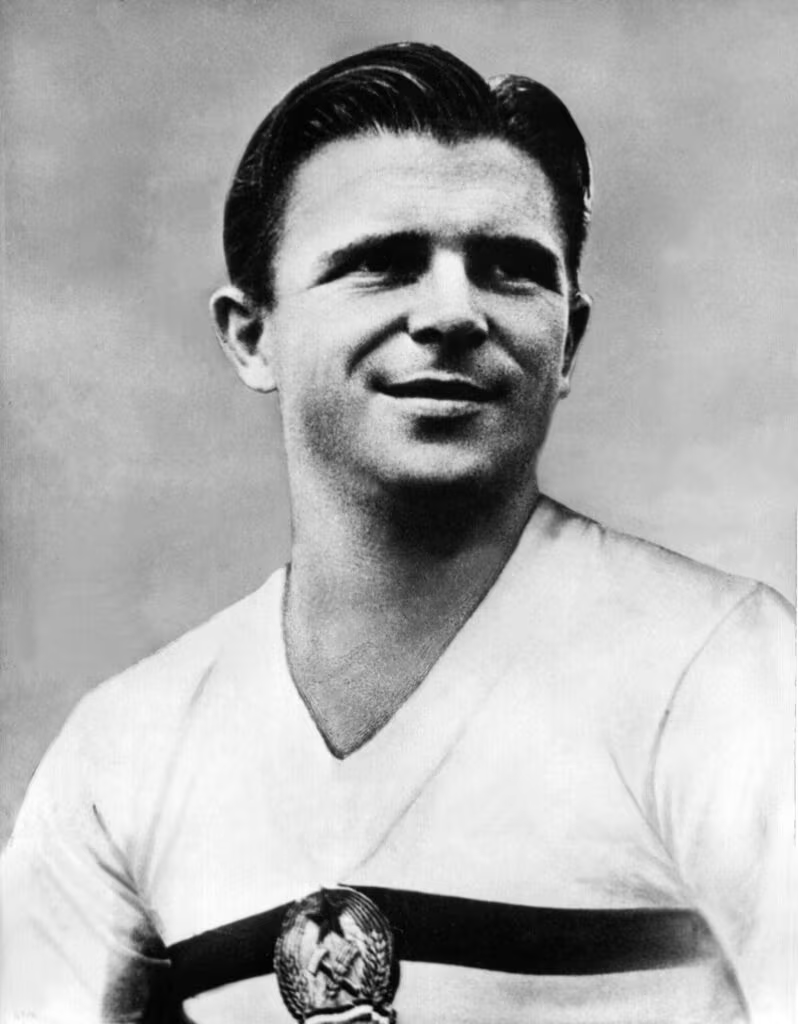
Di Stéfano in South America, him in Europe. The world sees the birth of two absolute phenomena at work, destined to set the scene alight - also as a pair - for twenty years.
Natural talent and unmatched creativity, Puskás at 21 is already an ace who leaves indelible marks: with Honvéd he scores something like 50 goals in 32 matches, and if the national team is added, he reaches 57 goals in 38 matches.
He is the world's top scorer of 1948, and the even crazier aspect is that he is not merely a finisher, but a complete forward, equally brilliant at providing assists of pure genius.
Another monstrous season for the captain of Toro: 25 league goals, Serie A runner-up top scorer, with his Granata reaching something like 125 total goals and accumulating several team records, some of which remain unbeaten even today in Italy's top division.
The only blemish: the 0-4 that the Ital-Toro suffers in Turin in a friendly against England.
Having exploded in the 1930s, he will play until the 1960s: he is the long-lived footballer par excellence, a bridge between eras, proof that clean breaks in football do not exist.
He is "Sir" Stanley Matthews, a superb winger and unmarkable when inspired, the greatest in the role until the arrival of Garrincha.
1948 is one of his best years: he is voted player of the year in the English season, drags his Blackpool to the FA Cup final - losing to Manchester United - and puts on a show in international friendlies, with England demolishing Scotland, Italy, Ireland and Switzerland.
Technical, versatile, powerful: he is one of the greats of Brazil in the late 1940s and in 1949 he produces a tremendous year. His 31 goals push Vasco to success in the Carioca championship, after the previous year the team had won the South American Championship of Champions, a competition that anticipated the Libertadores and was played only on that occasion among the winners of the South American national championships.
The icing on the cake in Ademir's golden year arrives between April and May 1949: the forward's 7 goals - he is proclaimed best player of the competition - push Brazil to victory, a milestone the national team had not reached since as far back as 1922, the era of the great Friedenreich.
The Hungarian bomber, having moved to the great Ferencváros, lives another monstrous season: 59 league goals in 30 matches, earning him first place in the scorers' chart and the team the Magyar title.
Deák is at the peak of his career, but soon his decline will begin, to which his opposition to the communist regime - which will exclude him from the national team - will also contribute.
The future Colonel and leader of the *Aranycsapat* confirms himself at an extremely high level: 46 league goals and 57 including the national team, in another particularly prolific year.
He is now considered the rising star of European football, ready to take the world throne in the 1950s.

The symbol of the Maracanaço, an achievement in some ways without equal in the history of football.
Without his charisma, Uruguay would never have defeated Brazil in its own home in front of 200,000 spectators who were waiting only to celebrate the triumph. There are no images of the match, but the accounts of all insiders indicate the Celeste leader as the true protagonist of the incredible success.
He is the best player of the World Cup, the author of fantastic plays throughout the entire competition - the *Corriere della Sera* correspondent compares him to Leonardo da Vinci painting football on the immense green canvas of the Maracanã - and he is also coming off a sumptuous season in Brazil with 20 goals in 32 matches.
In short: everything perfect, or almost. But at the final moment, the most important one, the atrocious mockery.
Were it not for the World Cup, the throne would be his. A sensational year for Puskás, who wins the Hungarian championship twice with Honvéd: the 1949-50 title and the 1950 title, 15 matches that inaugurate the new course wanted by the regime.
For Puskás, a total of 56 goals in 45 matches. With the addition of the national team, the haul rises to 68 goals, including a four-goal haul against Albania.